
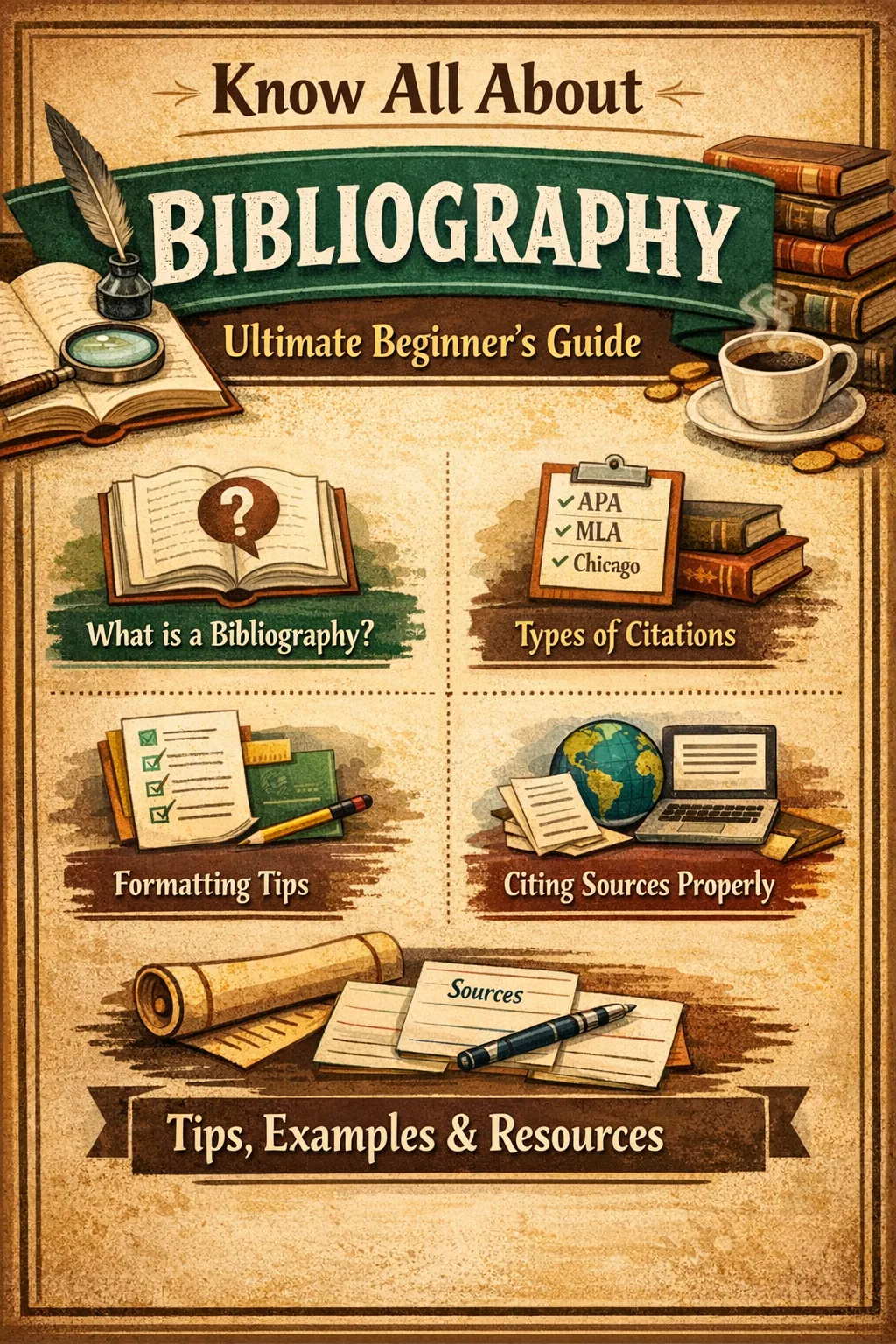
Bibliography plays a critical role in your academic work by providing proper credit to the authors and researchers whose work contributes to your own project. This guide ensures that you submit plagiarism-free and well-cited work. Also, to get this, you can use a plagiarism checker available online. Though the creation of a bibliography may seem challenging for beginners, it follows a structured design based on citation styles like MLA, APA, or Chicago. Thus, this practice helps avoid plagiarism and maintains academic probity. Assignment writing services often guide students on proper citation methods to ensure that their work meets the needed educational standards.
What Is Bibliography and How Do You Craft it?
A bibliography is a kind of reference list which you write at the end of your research paper. It contains each of the details of every source you use in your thesis, such as books, articles, or websites. Hence, this guide will help you on how to write a bibliography. Eventually, it ensures that the proper credit is given to the original authors and gives the reader a roadmap to find these sources for further reading. Also, to create one, you need to go through a few sets of rules.
The Bibliography Meaning
A bibliography is an alphabetised list of all the materials you go through during your research. It includes books, articles and websites, and you list these sources whether you quote them directly or simply use their ideas. The primary purpose is to give credit to the original authors. Also, it helps your reader to find those sources later after reading. This list is always found at the very end of your research paper.
Preparation Stage
It is the first stage where you craft a list of every source you use, even before you start your paper. Further, you record all necessary details such as author names, titles, and publication dates in one central place. Do not worry about perfect formatting, but capture the overall points. The primary goal is simply to ensure that no source data is lost. Thus, it makes your final submission much easier.
Collection Stage
Copy down each of the details you need for every source which you use when you collect details for your paper. Key details include the author’s name, the work’s title, the publisher’s name, and the publication date. Plus, you can use special software like a bibliography generater or a simple text file to keep the log organised and available throughout your research process. Moreover, the speed and accuracy here save time later.
Verification Stage
In this stage, you check your work once your paper is complete. You ensure that every source you write in the initial collection phase is actually in your final research. Also, verify that all details are complete and accurate. You must follow the specific style guide you were assigned, such as APA, MLA or simply search what does a bibliography look like. This careful checking prevents errors or any mistakes in the final list.
Construction Stage
You format all your collected data into one standardised list in this stage. You need to organise all the sources alphabetically by the author’s last name and follow every rule of your specified style guide carefully. Also, pay attention to the small details such as commas, periods, capitalisation and indentations. Check out the samples from reliable sites like Instant Assignment Help. This step recasts your raw notes into a proficient and academic bibliography for your final submission.
Final Audit Stage
It is the final stage in the creation of your bibliography. Read through your completed bibliography one last time with fresh eyes. Check for uniform design of how to do a bibliography for the whole document. Plus, do not forget to verify the correct spelling of all the names and titles. It ensures that every source you cited within your thesis is present in this final list with proper credits. This audit assures the accuracy and your paper’s credibility.
What Is the Difference Between Bibliography and References?
The core difference is simple. A bibliography is a long list of every source you used while learning about a topic. Also, it includes the background reading, which you didn’t quote. Its purpose is to show all your hard work and suggest extra books for the reader. Meanwhile, in the list of references, every source is directly mentioned or quoted inside your paper’s main text. Its goal is to prove where your specific facts came from. Thus, a reader can easily check your evidence.
Bibliography vs Reference
Understand how reference and bibliography differ from each other from the concise table given below. You’ll get to know what a reference and what is bibliography in on essay of your work looks like.
| Feature | Reference | Bibliography |
| Scope of Sources | Includes only sources directly cited, quoted, or paraphrased within the text. | Includes all sources consulted or read during the research process, whether cited or not. |
| Location in Document | Typically found at the very end of the document on its own page. | It is also found at the very end of the document. |
| Purpose | To allow readers to locate and verify the specific claims made in the text. | To demonstrate the breadth of the author’s research and provide background reading for the reader. |
| Common Styles | Associated with styles like APA Style, Harvard referencing, and some versions of Chicago (Author-Date). | Associated with styles like MLA Style, Chicago (Notes-Bibliography), Harvard referencing bibliography, and general non-fiction books. |
| Title of Section | Often titled “References” or sometimes “Works Cited” (specifically for MLA). | Usually titled “Bibliography” or “Selected Bibliography.” |
| Citation Format | Uses strict format rules for example, APA uses the phrase “References” | Follows specific style rules, often using the Notes-Bibliography format of Chicago style. |
Conclusion
Understand the key steps to make your bibliography and study the fundamentals of bibliographies vs. reference lists. The above beginner’s guide clarifies the citation styles of the work, purpose, and clear formats. Also, use a reliable plagiarism checker as it is a critical final step to verify originality. You can ensure that you’ve given the proper credits to everyone and master source tracking for academic integrity today. This process is crucial, and if time is short, you can use professional assignment writing services. It can help you to ensure that your work is in the right format. Thus, this guide makes mastering academic sourcing easy and efficient.