

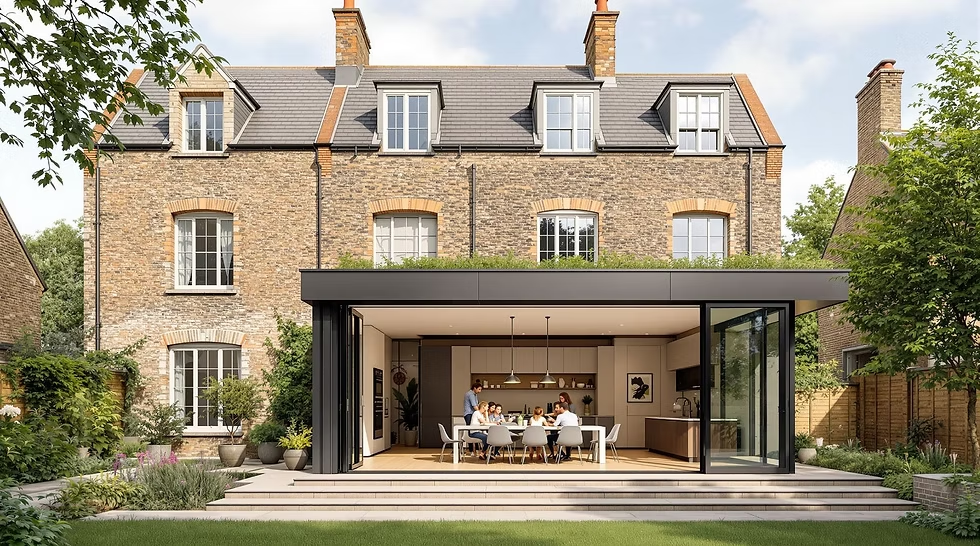
Croydon has become one of South London’s most active boroughs for residential improvement and small-scale development. From Victorian terraces near Addiscombe to 1930s semis in Shirley and larger detached homes in Sanderstead, the area offers strong potential for extensions, loft conversions and redevelopment.
But successful projects here depend on more than design ideas. They require a clear understanding of local planning policy, neighbourhood character and construction realities. If you are searching for architects in Croydon, it is important to work with a team that combines design thinking with planning strategy.
Understanding Planning in Croydon
London Borough of Croydon is one of London’s largest boroughs. It contains conservation areas, suburban streets, town centre regeneration zones and areas that border the Green Belt. Each location has different rules and expectations.
Architects working in Croydon must consider:
- Local Plan policies
- Supplementary Planning Documents (SPDs)
- Conservation area guidance
- Permitted Development rights
- Neighbour impact (daylight, privacy and outlook)
For example, a simple rear extension in Purley may be acceptable under Permitted Development, while the same depth and height in a conservation area could require full planning permission and heritage justification.
The difference often lies in detail. Ridge heights, roof form, window proportions and material selection can influence the outcome.
Types of Projects Architects in Croydon Deliver
1. Rear and Side Extensions
Rear extensions are among the most common residential projects in Croydon. Homeowners often want larger kitchens, open-plan living spaces or garden-facing family rooms.
Key design considerations include:
- Compliance with the 45-degree rule
- Height relative to boundaries
- Depth of projection
- Relationship with neighbouring windows
Wrap-around extensions are popular but require careful massing control. The aim is to increase floor space without overwhelming adjacent properties.
2. Loft Conversions
Loft conversions are frequently used to add bedrooms and bathrooms, especially in areas close to transport links.
Architects must manage:
- Dormer scale and placement
- Roofline impact
- Rear extension limits
- Party wall matters
In some streets, Article 4 directions remove Permitted Development rights. In these cases, a full planning application is necessary. Early review of constraints avoids delays.
3. Flat Conversions and HMOs
Croydon has experienced growth in flat conversions and Houses in Multiple Occupation (HMOs). These projects are more policy-driven and require strong technical compliance.
Important factors include:
- National space standards
- Bin and cycle storage
- Parking stress assessments
- Internal layout quality
- Sound insulation strategy
Designing purely for unit numbers without addressing these issues can lead to refusal. A planning-led approach ensures the proposal is defensible.
4. Small Developments and Infill Sites
Croydon’s town centre and areas near East Croydon station have seen increased development activity. Small infill sites require careful contextual design.
Architects must assess:
- Streetscape rhythm
- Building line consistency
- Daylight and sunlight impact
- Overlooking distances
- Refuse and servicing arrangements
Well-considered schemes that respect surrounding scale and character stand a stronger chance of approval.
Planning-Led Architecture: Why It Matters
In Croydon, design and planning cannot be separated. A visually impressive proposal that ignores policy risks refusal. Conversely, a modest but carefully justified scheme often secures approval more smoothly.
Before drawing begins, experienced architects will:
- Review planning history of the site
- Check designations (conservation area, Green Belt, Article 4)
- Assess neighbour relationships
- Analyse potential objections
- Identify key policy constraints
This early feasibility stage reduces risk and informs a more intelligent design.
Conservation Areas in Croydon
Croydon includes designated conservation areas where architectural character must be preserved or enhanced.
In these locations:
- Rear extensions may need to be visually subordinate
- Materials often need to match the original building
- Roof alterations require stronger justification
- Heritage statements are typically required
Contemporary design can still succeed, but it must demonstrate sensitivity to context.
Green Belt Considerations
Southern parts of the borough approach protected Green Belt land. Extensions in these areas must consider the concept of “openness”.
The planning authority assesses:
- Volume increase over the original building
- Visual impact
- Whether additions are “disproportionate”
Architects experienced in Green Belt policy understand how to design additions that remain compliant while still adding meaningful space.
From Concept to Construction
Residential projects in Croydon generally follow structured stages:
- Measured survey
- Concept design
- Planning drawings and submission
- Building Regulations drawings
- Tender documentation
- Construction phase support
Clear stage definition helps clients understand fees, timelines and deliverables.
Strong technical detailing at Building Regulations stage is particularly important in London, where construction costs are higher and mistakes are expensive.
Cost Awareness and Value
Good architects design with cost in mind. London build rates vary significantly depending on access, structural complexity and specification.
Common cost drivers in Croydon include:
- Steel beam installation
- Restricted site access
- Basement excavation
- Party wall awards
- High-performance glazing
Value engineering focuses on layout efficiency, natural light and long-term durability rather than unnecessary structural complexity.
Final Thoughts
Croydon offers strong potential for homeowners and developers. Its varied housing stock, improving transport connections and ongoing regeneration make it an attractive borough for investment.
However, planning policy remains detailed and context-sensitive. Success relies on thoughtful design, early feasibility work and realistic cost planning.
Architects in Croydon who combine design skill with planning expertise provide the greatest advantage. Whether you are extending your home, converting a property or developing a new scheme, a planning-led architectural approach increases the likelihood of approval and protects long-term value.
In Croydon, good architecture is not simply about aesthetics. It is about creating well-considered spaces that respect their surroundings, comply with policy and enhance both lifestyle and investment potential.