

Traditionally, business intelligence tools have relied on SQL and dashboard workflows to deliver insights to business organizations. Analysts use complex queries, join different tables, verify calculations, and finally deliver reports to business organizations. This approach to business intelligence has been used for decades to support business decisions in organizations.
However, as we move towards 2026, business organizations are asking a simple question: Can AI analytics tools replace manual SQL and dashboard workflows? The question is no longer abstract, given the significant advances in data analytics with AI.
The Challenges of Manual SQL and Dashboard Workflows
SQL is a powerful tool that organizations use to query data in their systems. However, it requires knowledge of the tool to deliver accurate results. This means that a simple mistake in a query can lead to inaccurate results, which can impact business decisions.
Manual workflows, on the other hand, involve business organizations requesting reports from data teams, analysts prioritizing tasks, and finally delivering reports to business organizations after a few days or hours.
The Limits of Manual SQL and Dashboards
SQL remains a powerful and reliable language for querying structured data. However, it requires training and experience. Even minor errors in joins, filters, or aggregations can lead to inaccurate reports. Additionally, dashboards often need constant maintenance as business metrics evolve.
Manual workflows create bottlenecks. Business users submit requests to data teams, analysts prioritize tasks, and reports are delivered after hours or days. In fast-moving industries, this delay can limit agility.
Dashboards, in particular, tend to reflect what has already occurred. While they can provide good visualizations of past performance, they do not necessarily offer any kind of explanation of what occurred.
These limitations have created interest in data analytics with AI, which promises to offer a more automated solution.
How AI Changes the Workflow
AI analytics tools use automation to replace much of the work that previously had to be done by hand. Instead of having to write a series of SQL queries, a user can simply ask questions in plain English.
Behind the scenes, the AI tool’s use of natural language processing determines what the question means, and machine learning determines what metrics to use, whether the data is unusual, and what trends exist. The results of the query can even be verified to prevent calculation errors.
This automation of query generation and analysis allows AI analytics tools to greatly speed up the reporting cycle, allowing a team to move from question to answer in a matter of minutes rather than days.
Can AI Fully Replace Analysts?
Although AI can assist with data analysis, there are many tasks that require human knowledge and experience. Data modeling, for instance, needs human expertise. Data engineers are required to ensure that the data pipelines are running properly, that the quality of the data meets the standards, and that the overall architecture meets the enterprise standards.
However, AI can replace a significant portion of repetitive tasks such as SQL queries, performance reporting, and root cause analysis. These tasks can be completed effectively with the assistance of AI.
Instead of replacing analysts, AI shifts their role. Data teams can focus on strategic modeling, forecasting frameworks, and long-term optimization rather than repetitive report generation.
Accuracy and Reliability
AI systems execute queries with precision and eliminate human error associated with spreadsheets. When connected directly to trusted sources of data, they also eliminate the possibility of data exported from those sources being too old.
With the improvement and refinement of AI systems and the introduction of better training and validation systems, the accuracy is also expected to be improved by 2026.
The Business Impact of Automation
While the impact of AI replacing manual workflows is not necessarily revolutionary, it is actually the speed and accessibility factor. When insights are not only quick but also conversational, more employees can be a part of the data-driven decision-making process.
Managers do not need to wait for the data teams for each change in the metrics. They can explore trends, test hypotheses, and receive explanations instantly. This strengthens overall business responsiveness.
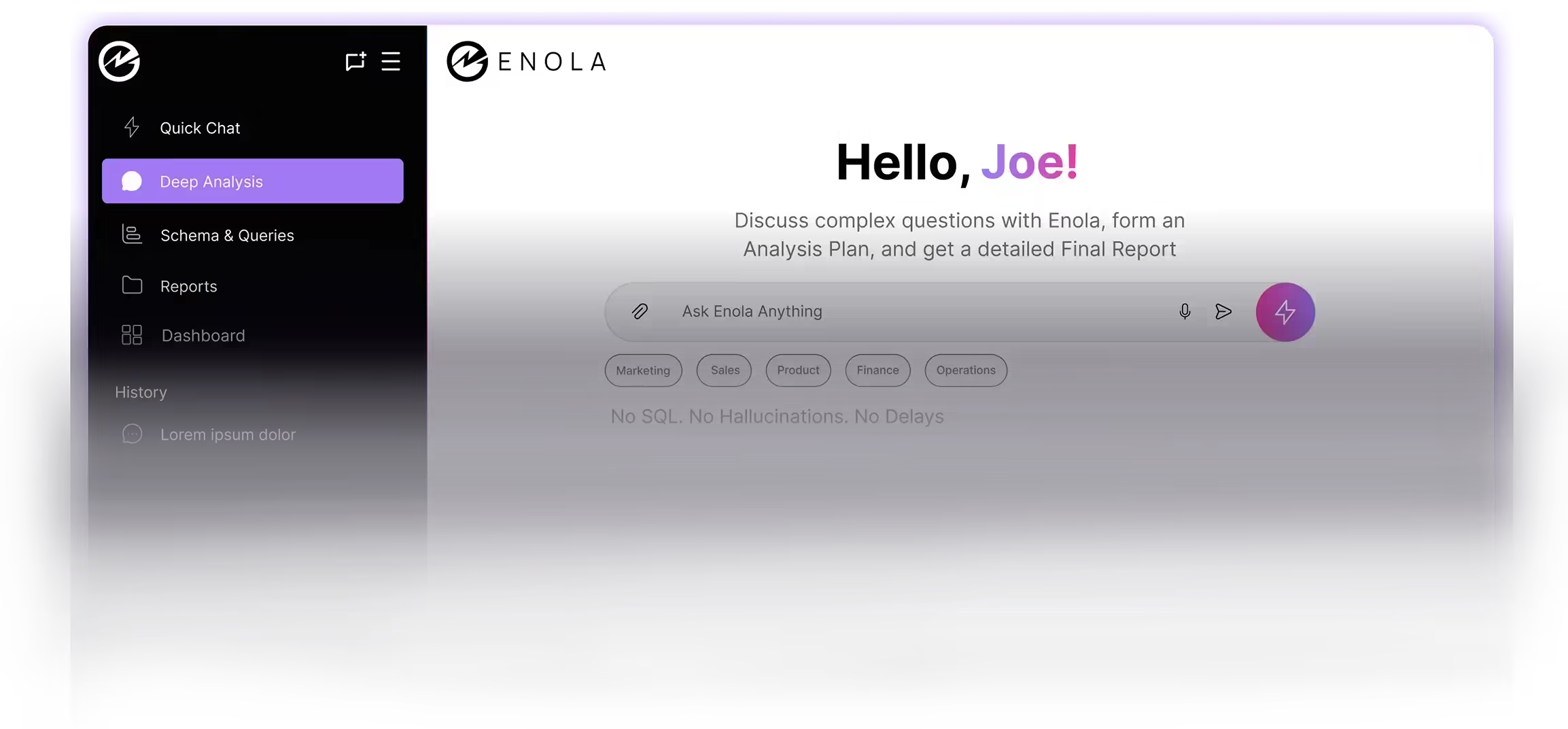
Platforms like AskEnola enable the automation of the entire analytics workflow without the need for manual SQL queries and insights creation. By integrating directly with enterprise systems, such platforms also eliminate the need for manual reporting and improve agility.
How Business Workflows Are Evolving
SQL is still a vital tool in the management of structured databases and the development of reliable data pipelines. However, the manner in which business workflows use SQL is evolving.
Rather than business users creating queries themselves, AI systems are now responsible for generating queries in the background.
On the other hand, business dashboards are becoming more interactive. This is a result of the evolving field of data analytics with AI, which enables the dynamic generation of insights rather than their static configuration. The overall shift in business workflows is not about replacing tools but making processes more efficient. AI analytics tools are making reporting processes more efficient and accessible to more business workflows.