

Key takeaways
- The choice is rarely “automate or not.” It is build it in-house, buy an integration, or keep doing it manually — and manual is the most expensive of the three once you price in recruiter time.
- Building resume parsing in-house means owning format coverage, multi-language support, accuracy tuning, and ongoing maintenance forever.
- A purpose-built parser that plugs into Oracle Recruiting Cloud via API typically integrates fast and removes both the apply-step friction and the data-cleanup burden.
- Decide with four questions: how much volume, how many languages and formats, how clean your existing data is, and who maintains it after launch.
If you run talent acquisition on Oracle Recruiting Cloud, you have almost certainly hit the same wall: resumes arrive faster than your team can turn them into usable, structured candidate records. The strategic question is not whether to automate the resume-to-profile step. It is how — build it yourself, buy an integration, or absorb the cost manually. This guide lays out the trade-offs so you can make the call with eyes open.
What are you actually deciding between?
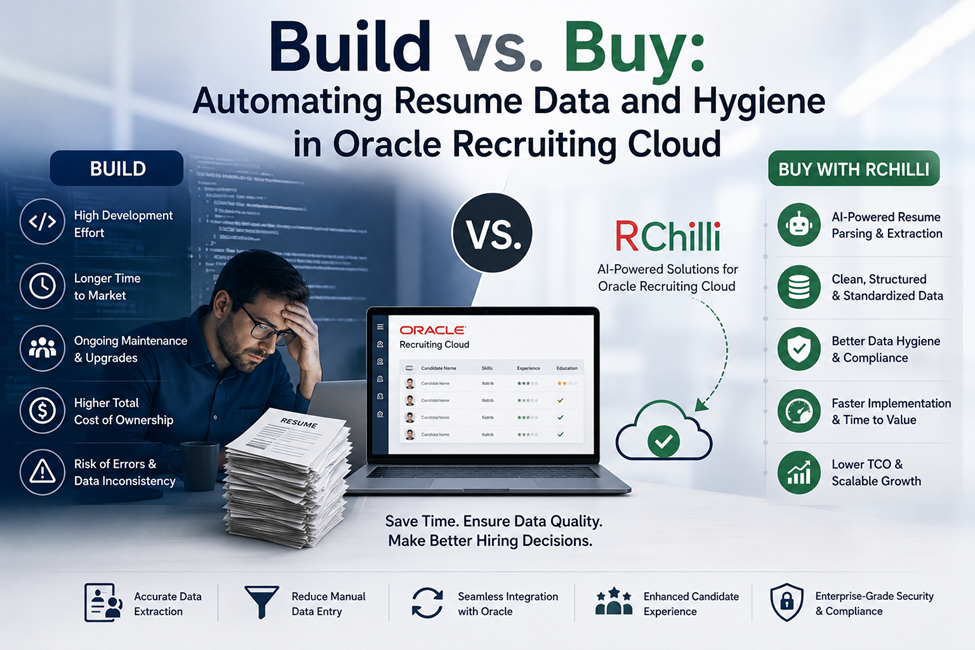
You are choosing among three operating models, and the real comparison is total cost and reliability, not licence price. The manual model uses recruiter hours to re-key resumes into Oracle; it has no software cost but the highest hidden cost. The build model uses your engineering team to create parsing and data-mapping logic against Oracle’s data model. The buy model uses a parser that already integrates with Oracle Recruiting Cloud through its API.
The reason this matters: Appcast research shows applications that take under five minutes complete at 12.47% versus 3.61% for those over fifteen minutes, and SHRM found 60% of candidates abandon long or complex forms. A slow manual or half-built process does not just cost back-office time; it quietly reduces how many candidates you capture in the first place. So “do nothing” is not neutral. It is the option that keeps leaking pipelines.
Should you build resume parsing in-house?
Building can make sense if you have a dedicated engineering team, low volume, and a single language and format to support — but that is a narrow set of conditions. Parsing resumes well is deceptively hard. A resume is unstructured text in endless layouts, and turning it into reliable structured fields means solving for:
- Format coverage: PDF, DOCX, HTML, scanned files, and the malformed exports candidates actually upload.
- Field extraction accuracy: correctly separating contact details, work history, job titles, education, skills, and certifications, then mapping them to Oracle’s fields.
- Multi-language support: if you hire across regions, your parser must read CVs in many languages and still produce a consistent data model.
- Maintenance, forever: resume styles change, edge cases pile up, and someone on your team owns that backlog indefinitely.
The honest in-house cost is not the first version. It is the second year, when accuracy plateaus, the original engineers have moved on, and parsing quality silently decays while recruiters quietly go back to manual fixes. Most teams that build eventually discover they have created a maintenance liability rather than a competitive advantage, because parsing is not where their product differentiates.
When does buying an integration win?
Buying wins when volume is real, formats and languages vary, and you want the apply-step and data-cleanup problems solved together without a multi-quarter engineering project. A purpose-built parser that already connects to Oracle Recruiting Cloud removes the two jobs you would otherwise own: converting resumes into structured Oracle profiles, and keeping that data clean over time.
This is the model RChilli’s Oracle HCM integration is built around. It plugs into Oracle Recruiting Cloud through APIs and covers the full chain rather than a single step:
- Enhanced Candidate Profile Import parses each uploaded resume into a complete, structured profile inside Oracle, across PDF, DOCX, HTML, and all languages Oracle HCM supports — which is what enables a one-click, prefilled application instead of a manual re-entry form.
- Data Hygiene (Quick Apply, Full Database Reprocessing, List of Values, and Customizable Taxonomy) keeps the database current and consistent, standardizing skills and titles against a taxonomy of millions of skills and job profiles.
- Recruiter Hub connectors (Browser Assistant, Email Importer, Bulk Data Import) pull resumes from job boards, inboxes, and file repositories straight into Oracle.
The practical advantage is speed and scope. You are not budgeting a build; you are configuring an integration that addresses capture, cleanup, and sourcing as one system.
How do you decide? Four questions that settle it
Run your situation through these four. The answers point clearly to build, buy, or fix-manual-first.
- What is your volume? Low and stable favors keeping it simple or building. High, spiky, or growing volume favors buying, because manual and home-grown approaches break under load exactly when hiring matters most.
- How many formats and languages? One language and a clean format set is buildable. Multi-format and multi-language hiring is where purpose-built parsers pull decisively ahead, because that coverage is the hard part to build and maintain.
- How clean is your existing Oracle data? If you already have years of duplicates, inconsistent titles, and stale records, you need reprocessing and standardization, not just go-forward parsing. That tilts toward a solution with data-hygiene tooling built in.
- Who owns it after launch? If the honest answer is “no one has bandwidth,” do not build. Unmaintained parsing degrades, and the cost reappears as recruiter rework.
If three of your four answers point to “buy,” the next step is a scoped pilot: parse a sample of real resumes into a test Oracle tenant and measure profile-creation time and field accuracy against your current manual baseline.
What about data you already have in Oracle?
Go-forward parsing only fixes new applications. The records already sitting in your Oracle tenant are usually the bigger liability, and they are easy to forget in a build-vs-buy debate. Gartner estimates poor data quality costs organizations an average of $12.9 million per year, and in recruiting that surfaces as duplicate candidates, unsearchable skills, and reporting you cannot trust.
This is a strong argument against pure in-house builds, which tend to focus on the parsing step and skip historical cleanup. A buy option that includes full-database reprocessing can refresh existing candidate records using the latest CVs and a consistent taxonomy, so a skills-mapping or internal-mobility initiative starts from clean data rather than a backlog. If your decision criteria stop at “can it parse new resumes,” you will solve half the problem.
How should you weigh integration speed and security?
For most enterprise Oracle environments, these two factors break ties. On integration speed, an API-based parser designed for Oracle Recruiting Cloud can be connected and configured quickly, often in well under an hour once prerequisites are in place, versus the multi-sprint reality of an in-house build. On security, anything touching candidate PII has to clear your privacy review, so confirm certifications and data-handling up front. A mature vendor will hold recognized compliance credentials and avoid storing resume data after parsing, which simplifies your GDPR and internal due-diligence path. A home-grown tool inherits none of that posture by default; you build and certify it yourself.
A simple decision summary
- Keep manual only if volume is low and likely to stay there. Otherwise it is the most expensive option in disguise.
- Build only if you have a dedicated team, narrow format and language needs, and a committed long-term owner.
- Buy when volume is real, formats and languages vary, your existing data needs cleanup, or you want capture and hygiene solved together fast.
Most Oracle Recruiting Cloud teams running meaningful hiring volume land on buy, because parsing and data hygiene are mission-critical but are not where their organization should be spending engineering effort.
Frequently asked questions
Is building a resume parser cheaper than buying one? Rarely, once you include maintenance. The first version may look cheap, but accuracy tuning, format and language coverage, and ongoing upkeep make in-house parsing a recurring cost. Buying converts that into a predictable integration with coverage maintained for you.
Can a third-party parser work inside Oracle without disrupting workflows? Yes. Parsers built for Oracle Recruiting Cloud connect through APIs and populate Oracle’s own fields, so recruiters keep working inside Oracle as usual while the parsing and data-mapping happen behind the scenes.
What about historical candidate data already in Oracle? Look for full-database reprocessing. It re-runs existing records through current parsing logic and a standard taxonomy, refreshing contact details, normalizing skills, and aligning job titles so your existing data becomes reliable for search and reporting.
How long does it take to integrate a parser with Oracle Recruiting Cloud? API-based parsers designed for Oracle are typically fast to connect, often configured in under an hour once technical prerequisites are met, compared with the multi-quarter timeline of building equivalent capability in-house.
About the author: This article was contributed by the RChilli team, which builds AI-powered resume parsing, data hygiene, and unbiased-hiring solutions embedded inside Oracle Recruiting Cloud and other enterprise HCM platforms. Industry statistics are attributed to their original publishers (Appcast, SHRM, Gartner) and reflect the most recent figures available at publication.