

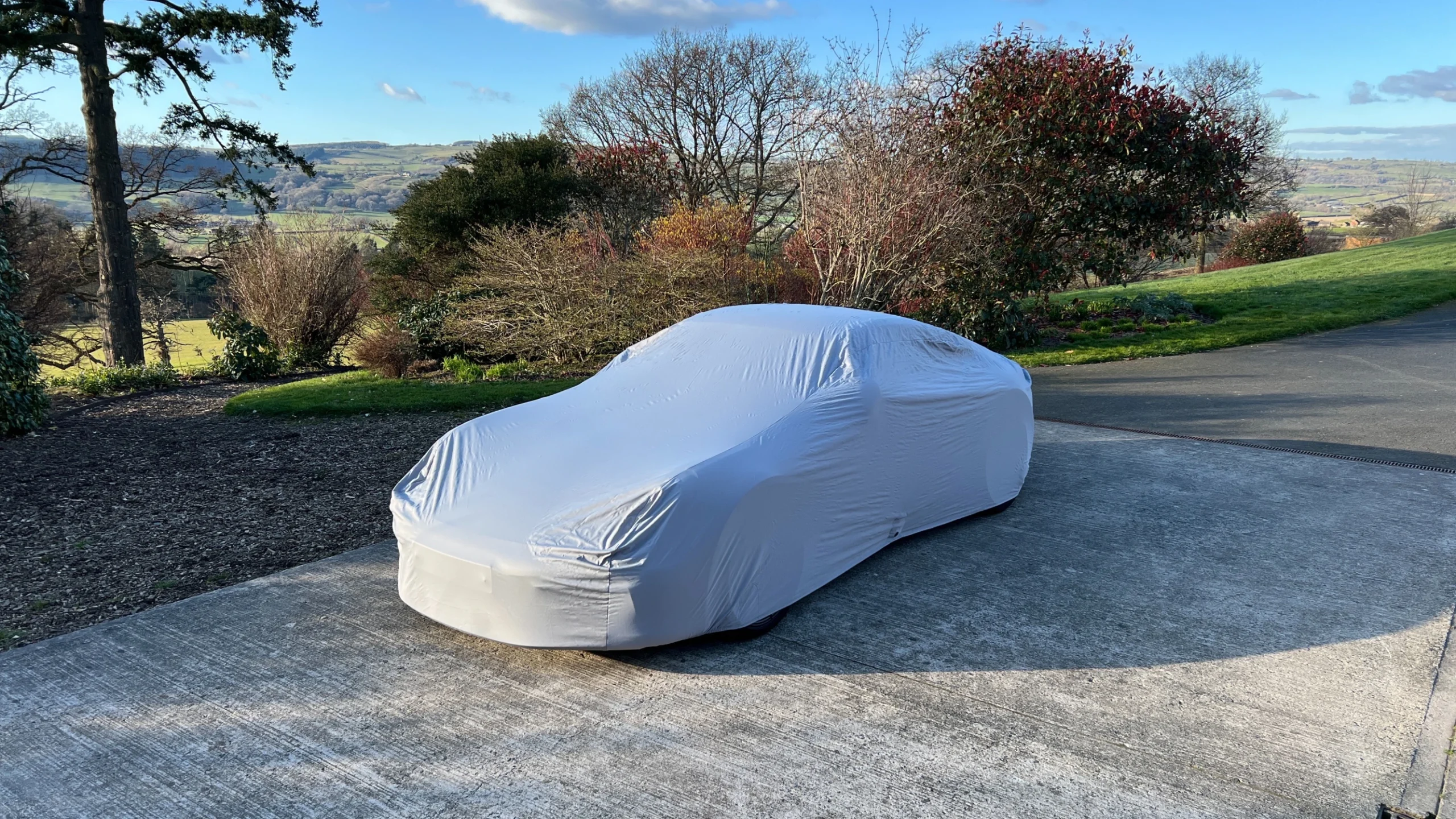
Many folks think of a car cover as something inconsequential, a sub-50 dollar sheet of nylon to throw over the hood. For a classic vehicle, that’s costly thinking. The “paint” on the outside of a classic car is the life of the vehicle, the actual physical form and shape of all those memories. Once it’s altered, it can never be the same. Know thy enemy, the chemistry of his ways, and the workmanship to defeat him, is the only answer when the stakes are that high.
Single-Stage Paint and Why Classics Are Far More Vulnerable
Modern cars have paintwork that’s tough. It’s a dual-stage paint system, a pigmented base coat sealed under a separate clear coat. The base coat gives the colour, the clear coat is sacrificial and stops most chemicals and the sun’s ultraviolet light from striking the base coat itself. As long as the base coat is sound, damage is mostly cosmetic.
Oftentimes, even if the clear coat is suffering from UV damage (giving a ‘freckled’ appearance) or a chemical etch, it can be compounded, polished off, or the top layer resprayed. None of the underlying colour is lost, so both these measures maintain the car’s integrity.
Classic vehicles are a different story. Most older paintwork uses single-stage lacquer, where the pigment and the binder are one and the same. There’s no protective clear layer sitting above the colour. That means any oxidation, acid etch, or abrasion attacks the colour itself directly. Restoration costs climb fast. More critically, respraying a classic car almost always reduces its value, because a matching respray, however skilled, will never perfectly replicate decades-old factory paint.
This is why classic car covers aren’t a cosmetic accessory. They’re structural protection for something that cannot be undone.
Why Universal-Fit Covers Are a Physical Hazard
An ill-fitting cover can cause more damage than having no cover at all. This is because when the wind blows under a loose cover it causes the cover to flap and scrape over the painted surface of the vehicle. This can act like sandpaper to the paintwork, creating swirl marks and micro-scratches which dull the finish. On single-stage paint, this kind of abrasion directly removes colour.
That’s why car covers from Classic Additions are tailored to the exact dimensions of each vehicle model. This guarantees that the cover remains securely in place over the vehicle without the need for tie-downs. Coverings protect the surface of the bodywork from dust and other dirt, while at the same time being breathable to ensure that any dirt or moisture beneath the coverings can escape.
The Chemistry of UV Damage
Sunlight does more than fade paint. It physically degrades it. Ultraviolet radiation bombards the polymer chains in paint binders through a process known as photodegradation. As these chains break, the paint can no longer hold the pigment particles together. And a chalky, matte surface is the seeable result of structure failure in the paint.
For single-stage lacquer, this happens even faster since there is no clear coat buffer to block UV light. For instance, unprotected outdoor parking can lead to visible oxidation in a single season in certain high-UV environments. This damage accumulates and is largely irreversible without mechanical correction, cutting back the oxidised layer, which means removing material that can’t be replaced.
UV-treated cover fabrics prevent this phenomenon. A good cover fabric blocks, absorbs, and reflects the UV before it can hit the paint surface, essentially providing the sacrificial layer that the paintwork lacks.
Heat Expansion and the Window For Acid Attack
Not only does UV radiation damage the paint, it also heats the metal. Automotive body panels can exceed 140°F (60°C) on a clear day. Paint expands and the pores of the surface open up. Droppings carry uric acid at a pH of 3.0 to 4.5. The acid doesn’t just sit on top, it sinks into the softened material. As the temperature drops overnight, the paint contracts and traps the acids inside the surface. The same happens with tree sap. The organic terpene compounds in sap bond chemically to the paint surface. As the sap dries and shrinks, it pulls at the clear coat or lacquer. Acid rain forms dilute acids that concentrate on horizontal surfaces as water evaporates. A well-fitted cover keeps these surfaces completely dry.
The Breathability Paradox
This is a mistake that many people make. They think that the more sealed off a cover, the better. So, they choose something like a heavy plastic tarp. Some even use a rubber-lined sheet. But the problem is that a fully waterproof cover traps any moisture that’s already in or under your car. And every vehicle has some moisture in its panels.
Also, if your car is parked in a concrete garage, the floor will release rising damp, which then condenses on the cold metal of your car. Lastly, temperature differences will cause condensation to form under anything that’s not breathable. If the moisture has nowhere to go and is up against the metal surface, it’ll encourage corrosion. It’ll also let mold grow and in some cases, force blistering by pressure of moisture. This is when bubbles appear in the paint due to moisture pressure.
In sum, you don’t want to keep all the water out. You want a cover with a high water vapor transmission rate (WVTR). This means you want a breathable and water-resistant fabric that allows both liquid water repellency from above and the easy-escape of moisture vapor from the inside. The microclimate under the cover remains dry and stable. This simple rule applies if you’re covering any car with its original or restored paintwork.
The Layers That Make a Cover Work
A top-notch cover for outdoor storage is not just one kind of fabric, it’s a combination. The outer fabric has to be rugged, UV-stable, and water-resistant but not waterproof. UV-stabilised polypropylene or a formulated polyester material are good choices for this layer. These aspects of the cover handle the harshest treatment from the environment so your vehicle’s paint doesn’t have to.
The inner fabric must be soft, probably the most important piece of the puzzle. Anywhere the cover comes in contact with your paint, the fabric must be soft enough that no abrasion could ever take place from any movement of the cover. Fleece is used in most good covers, because the fibers are fine, soft, non-abrasive, and won’t trap larger dirt particles against the paint. A stiff inner layer, even if completely clean, spells danger every time the cover is slid off or on.
A membrane in between these two layers introduces an extra moisture barrier. This might or might not be necessary for your conditions. If your vehicle is even occasionally parked in a damp area or someplace where temperatures swing, it’s a good idea to have this extra layer.
The Indoor Storage Myth
Storing a classic in a garage doesn’t mean protection. This misconception ensnares many owners.
Garage environments pose their own threats. Concrete ‘breathes’ moisture, while in an unheated garage temperature ‘sweats’, leading to condensation directly on metal surfaces of the vehicle. Garage dust isn’t simply innocuous dirt; it’s often comprised of tiny abrasive particles that scratch paint, disturbed by even the gentlest waft of air. And items such as these will be drawn by static electricity to ‘stand’ against any exposed dry-painted section.
Then there’s the inadvertent contact, a ladder shifted in the breeze, a toolbox handle striking the wing, a door swung wide as something else is being removed. These are the kind of assaults that are not only instantly visible but, because they shear rather than abrade surrounding paint, virtually impossible to compound out of original paintwork.
An indoor cover looks after all of this. It keeps things dry, keeps dust away, and keeps the unknown object away from your pride and joy with a soft, cushioning layer. The technology in achieving this is radically different from that needed for outdoor protection but is no less demanding for the inner surface and the overall fit.
What to do Before the Cover Goes on
The most prevalent mistake many people make when using a car cover is to throw it over a car that is not absolutely clean. A cover put onto a dirty car, or a wet car, will cause immense damage to the car’s paintwork. Dirt becomes trapped between the cover and the car and acts as an abrasive compound as wind (or people) move the cover “across” the car. Dirt on the surface of a scratchless car will get picked up by the edges of the cover and scrubbed all around the paint surface causing minute scratches all over.
This can be compared to the effect of a kitchen scouring pad on a non-stick pan! Moisture will create the same effect except on this occasion it will be the corrosion and staining that is accelerated. The “perfect” environment to store a car is in a dry, stable temperature, low humidity, and of course no dust. A car cover must breathe, but moisture cannot evaporate through it if it is already wet to start with.
Before covering, the vehicle should be fully washed and dried, paying particular attention to panel gaps where water collects. Allow the bodywork to return to ambient temperature; a hot bonnet fresh from a drive will generate condensation under even a breathable cover as it cools. A layer of quality wax or paint sealant applied before covering gives the paint surface its own chemical barrier, adding a further layer of protection against anything that does make contact during storage.
The Financial Case For Proper Protection
The factory paint that originally came on the car is a tangible part of its value on the market. In the world of classic cars, original paint and matching numbers command a premium that no excellent repaint can fully compensate for. The cost of a properly designed, custom cover is incredibly cheaper than one professional paint correction, not to mention a whole new paint job.
At this level of protection, emotions aren’t the purpose. It’s the easiest type of asset preservation available to any classic car owner. The car will depreciate less, remain in better working order, and sell for more if you decide to sell it at any point. But more importantly, the paint will remain exactly what it should be: what left the factory, untouched, and telling the perfect story.