

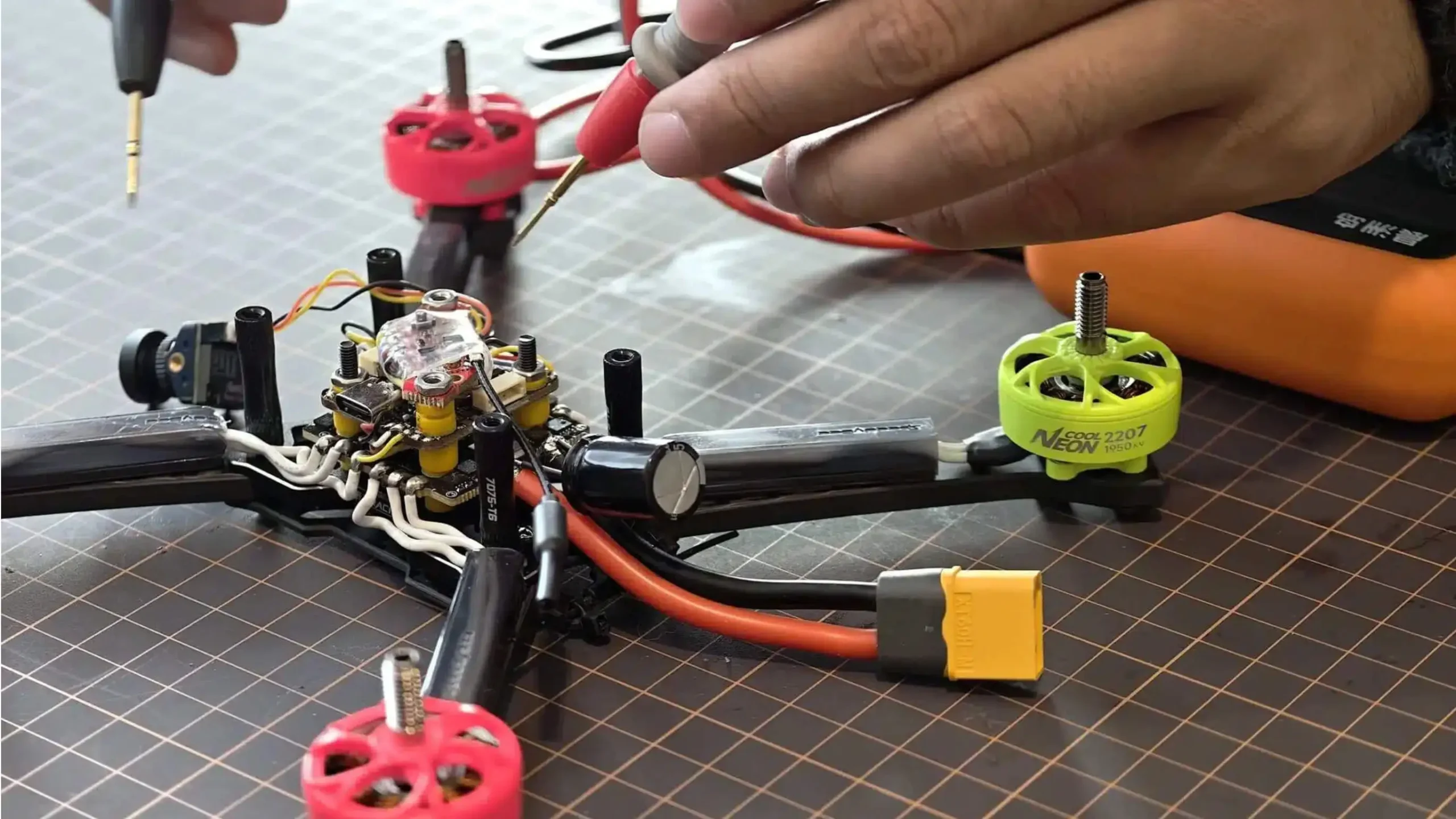
An FPV drone may have a powerful motor, a modern flight controller, and a high-capacity battery, but none of those components can work properly without a suitable electronic speed controller.
The ESC, or electronic speed controller, is responsible for controlling the electrical power delivered from the battery to the motor. It sits between the battery, flight controller, and brushless motors and plays a critical role in how the aircraft responds to throttle commands.
Understanding how a drone ESC works can help pilots choose compatible electronics and avoid common power-system problems.
The Basic Function of an ESC
A brushless motor cannot simply be connected directly to a battery and controlled like a traditional brushed motor.
The ESC rapidly switches electrical current between the motor’s phases. By controlling this switching process, the ESC determines how quickly the motor rotates and how it responds to commands from the flight controller.
When the pilot moves the throttle stick, the radio system sends the command to the receiver and flight controller. The flight controller processes the input and sends motor commands to the ESC. The ESC then adjusts electrical power to the motors.
This process happens extremely quickly, allowing an FPV drone to make precise changes in speed and attitude.
Why ESC Current Rating Matters
One of the most important ESC specifications is current rating.
For example, an ESC may be rated at 35A, 45A, 55A, or 60A. This rating indicates how much current the ESC is designed to handle under specified conditions.
However, selecting an ESC simply because its number is larger is not always necessary.
The required current depends on the motor, propeller, battery voltage, and flying style. A lightweight 3-inch drone may have very different requirements from a powerful 5-inch freestyle quad.
If the motors can draw significantly more current than the ESC can safely handle, the ESC may overheat or fail during aggressive throttle use.
A sensible design should therefore leave some safety margin between expected motor current and ESC capacity.
4-in-1 ESCs Are Popular in FPV
Many modern FPV drones use a 4-in-1 ESC.
Instead of installing four individual ESCs, a 4-in-1 board contains four motor controllers on a single circuit board. This makes wiring cleaner and simplifies installation.
A 4-in-1 ESC is commonly mounted below or above the flight controller using the appropriate mounting hardware.
This configuration has become particularly popular for 5-inch and larger FPV builds because it reduces wiring complexity and keeps the electronics organized.
Battery Voltage Compatibility
Battery voltage is another critical consideration.
An ESC must be compatible with the battery voltage used by the drone. A 4S configuration has different electrical requirements from a 6S system.
For example, a pilot building a modern 5-inch 6S freestyle quad should select an ESC specifically designed to support the expected battery voltage.
Voltage compatibility is not something that should be treated as an optional feature. Using an ESC outside its intended electrical range can result in serious hardware damage.
ESC Firmware and Communication
Modern FPV ESCs can do more than simply control motor speed.
Many support digital communication protocols that allow the flight controller to communicate detailed motor commands to the ESC. Some systems can also report information such as current, voltage, RPM, and temperature depending on the hardware and firmware.
This information can be useful when diagnosing problems or tuning the drone.
For example, RPM feedback can be used by certain flight-control systems for advanced filtering and motor-control features. Current telemetry can also help pilots estimate battery consumption and identify unusual power behavior.
ESC and Motor Compatibility
An ESC should always be evaluated together with the motor.
Suppose a motor produces high thrust using an aggressive propeller. Under full throttle, the motor may draw substantial current. The ESC needs enough capacity to handle this demand without excessive heat.
The combination of motor KV, propeller pitch, blade count, and battery voltage can have a major effect on current consumption.
For this reason, pilots should look at motor test data when available instead of relying only on the nominal motor size.
Active Braking and Modern ESC Features
Many modern FPV ESCs support active braking.
Active braking allows the ESC to reduce motor rotation more aggressively when the flight controller needs a rapid change in motor speed. This can contribute to a more responsive flying experience.
Other features may include telemetry, programmable settings, temperature protection, current monitoring, and compatibility with different ESC firmware platforms.
Not every pilot needs every feature, but advanced capabilities can become useful as the build becomes more sophisticated.
Common ESC Problems
ESC failures can result from several causes.
Excessive current is one common problem. A motor-propeller combination that draws too much power can generate significant heat.
Physical damage is another issue. A hard crash can damage an ESC board, especially if the electronics are exposed.
Poor soldering can also cause problems. Cold joints, excessive solder, damaged pads, or loose battery connections can introduce electrical resistance and heat.
Finally, incorrect firmware configuration can create communication or motor-control problems.
How to Choose an ESC
A practical selection process should begin with five questions.
What battery voltage will the drone use? What motors are being installed? What propellers will those motors turn? How much current can the system generate? What features are actually needed?
For most FPV builds, selecting the ESC after deciding on the motor and propeller combination makes the process easier.
MEPSKING provides a range of FPV electronics and drone components for pilots building or upgrading their aircraft. The important thing is to compare specifications across the complete power system rather than selecting an ESC based only on price or current rating.
Final Thoughts
The ESC may not be the most visible component on an FPV drone, but it is one of the most important.
A correctly selected ESC provides the electrical bridge between the flight controller, battery, and motors. When voltage, current capacity, firmware, and physical compatibility are all considered together, the power system becomes safer and more predictable.
For beginners, understanding ESC fundamentals is one of the best ways to move beyond simply assembling parts and start designing better-performing FPV drones.