

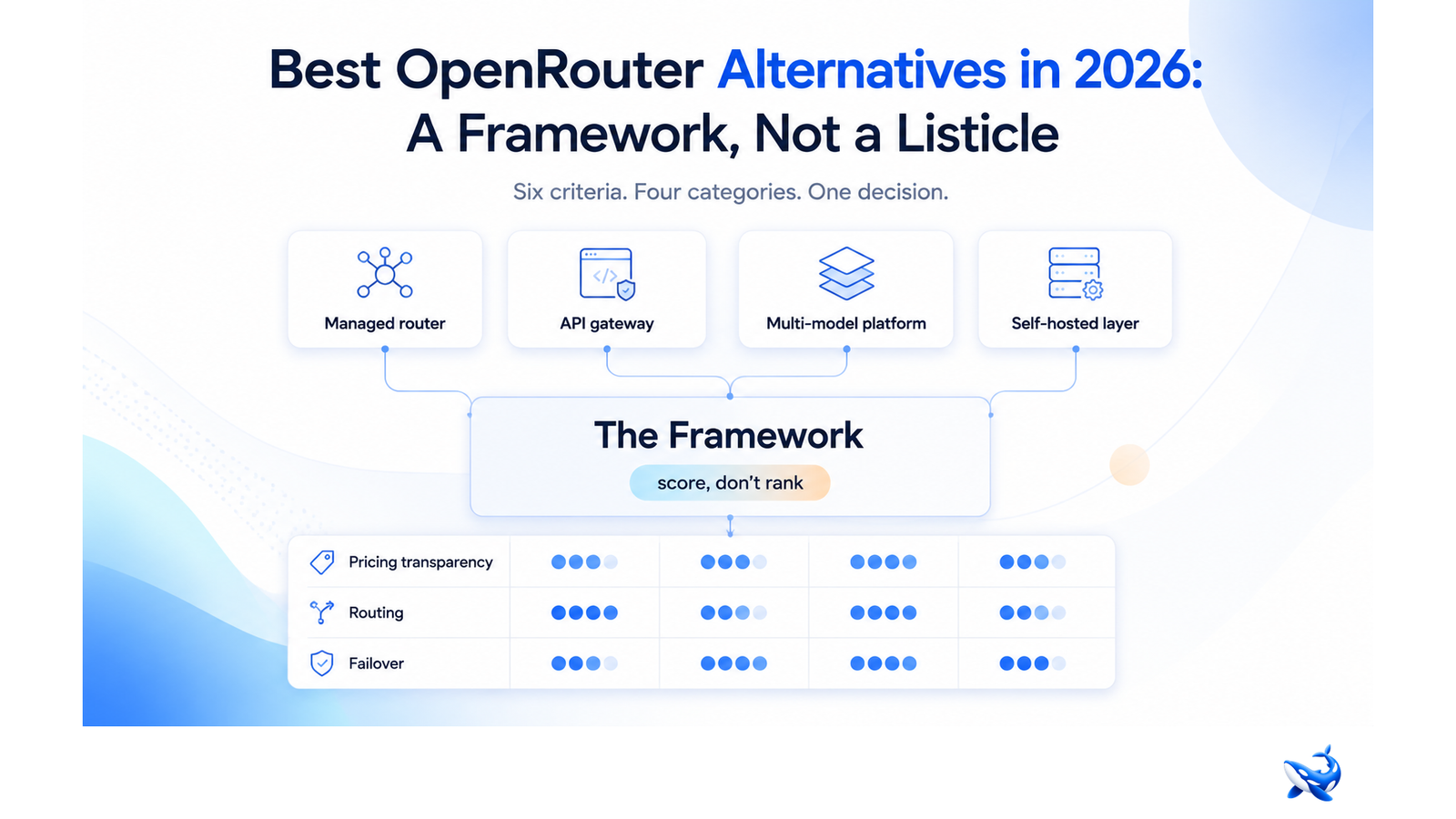
When you search for the best OpenRouter alternatives, you get a wall of listicles that rank a handful of vendors and stop. The useful version is a framework: the categories of alternative that exist, the criteria that separate a genuine router from a reseller, and where OrcaRouter fits inside it. Line the candidates up against the openrouter alternative framework, take it to any shortlist, and the list writes itself.
The timing is real. Model releases reset the quality leaderboard every few weeks, prices move monthly, and your workload is too big for any single provider. Teams that bought an aggregator in 2024 are re-buying in 2026 because they optimized the wrong axis — they compared model counts and dashboards instead of the incentives underneath. This article gives you the scoring grid, not the rankings: four categories of alternative, six criteria to test each one, and an honest read of where each category wins and loses.
The four categories of alternative
Before scoring anything, sort the market into four buckets. Most “alternatives” you’ll find are one of these under a different name.
Managed AI routers. Purpose-built services that sit between your code and every provider, decide which model answers each request, and handle the retry-and-switch mechanics for you. This is the category that actually does routing — grading a prompt and sending it to the cheapest model that meets your quality bar — rather than just forwarding traffic.
API gateways. General-purpose gateways that add rate limiting, auth, and traffic control in front of your existing APIs. Mature and reliable, but they were designed for REST traffic, not model economics. They will not optimize your per-token spend, because routing a prompt by cost was never their job.
Multi-model platforms. Developer platforms that host many models behind one endpoint and one key. Broad catalogs and familiar DX, but the business model is reselling tokens — which means the margin is yours, hidden inside the price per token. Convenience is real; cost transparency usually is not.
Self-hosted routing layers. Open-source libraries and proxies you run yourself. Maximum control, minimum hand-holding: you own the deployment, the failover logic, and the on-call rotation when a provider blinks at 2 a.m.
Six criteria to score every alternative
Score each candidate on six axes. Anything a vendor refuses to answer in an afternoon is a red flag by itself.
| Criteria | What actually matters | Red flag |
| Pricing transparency | Vendor list price passed through at 0% markup, itemized receipts | The platform can’t state its margin |
| Routing | Per-request grading, sending each prompt to the cheapest model that meets your bar | Round-robin or static load balancing |
| Failover | Automatic handoff to a second provider on first error | Retry logic left to your code |
| Observability | Per-request logs with model, latency, and cost | Logs that hide which model answered |
| Governance | Budgets, roles, guardrails, BYOK | Spend controls bolted on as an upsell |
| Migration ease | An OpenAI-compatible endpoint your existing client can call | A proprietary SDK that rebuilds your stack |
Pricing transparency
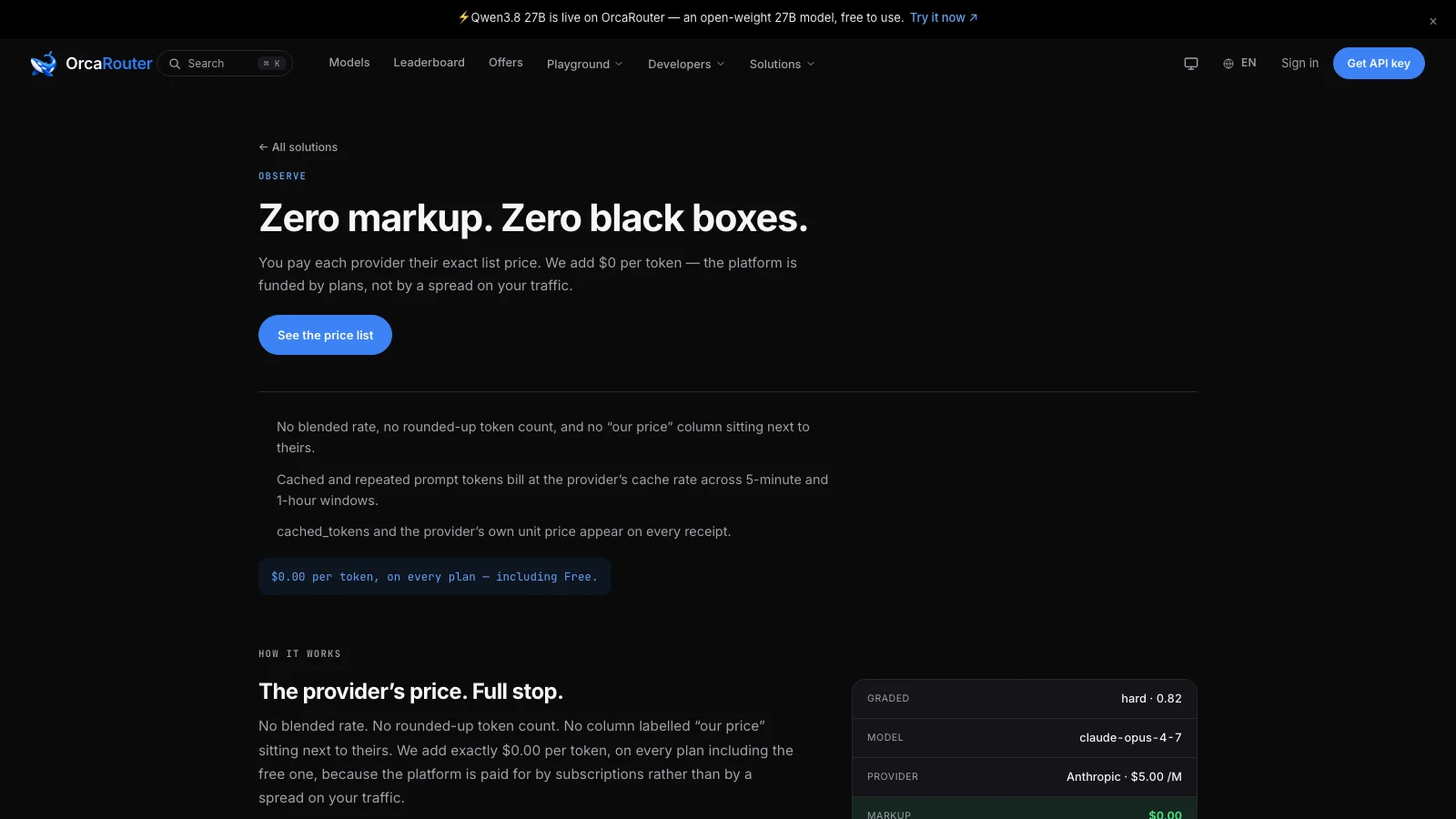
This is the fastest filter, and it is where resellers lose. The bar is simple: charge exactly the vendor’s list price with no markup, and show an itemized receipt for every request. If a platform cannot tell you the margin it takes, it is taking a margin. In a category built on re-selling tokens, this single criterion eliminates most of the market before you look at anything else.
Routing and failover
Any service with a load balancer can claim “routing.” The difference is what happens per request and on the worst day. A router grades each prompt — in under a millisecond, when done properly — and sends it to the cheapest model that meets your standard, instead of pinning traffic to one expensive flagship. And when a provider errors, automatic failover hands the request to a second provider the moment the first fails. An outage turns into a log line, not a production incident.

Observability and governance
Per-request logs are the operational contract: which model answered, what it cost, how long it took. You cannot optimize what you cannot see, and you cannot defend an invoice you cannot itemize. Governance is the same muscle applied to people — budgets and roles so a teammate cannot accidentally burn the spend, guardrails at the gateway instead of inside every prompt, and BYOK for teams whose procurement process cannot add a new vendor without a contract cycle.
Migration ease
The shortest path to value is an endpoint your existing code can already call. If you have written against the OpenAI API format, the router’s endpoint should accept the same request and return the same response — drop-in, no mapping layer. A proprietary SDK quietly converts a commodity into a dependency and locks your migration cost into the decision.
Where OrcaRouter fits the framework
On that grid, [OrcaRouter] is a managed router — and its business model is the tell. It passes provider list prices straight through at 0% markup, so it never benefits from steering you toward pricier models; the routing decision is yours to make, and the platform’s incentive is to be the honest pipe, not the toll booth. That removes the conflict of interest that makes reseller platforms a permanent tax on your bill.
On the two axes that decide the bill, it wins outright. Routing is adaptive: every prompt is graded in under 1ms and sent to the cheapest model that meets your quality standard, with an orcarouter/auto mode and prefix-aware, session-aware routing for workloads that need context. Cost transparency is structural: the same 0% markup policy, receipts you can read line by line, and pricing published per model rather than negotiated in private.
The rest of the grid holds up in production. One API key reaches 200+ models across all major vendors. Automatic failover, load balancing, prompt caching, per-request observability with audit-grade request logs, budgets and roles, BYOK, an agent firewall, and an OpenAI-compatible endpoint cover the observability, governance, and migration-ease columns. For a team currently on the most popular marketplace — the default choice that most “best OpenRouter alternatives” searches start from — the migration is a config change, not a rewrite.
Two honest caveats. Self-hosted layers beat a managed router on control for the rare team that needs air-gapped routing, at the cost of owning the ops. And a managed router is a subscription, so teams with near-zero traffic should be honest about whether the automation is worth a monthly line item yet. For everyone whose LLM spend is real and growing, the managed-router category — and OrcaRouter within it — is where the bill and the uptime get looked after.
The takeaway
Use the framework, not the rankings. Score on pricing transparency first — it filters out half the market in an afternoon. Then verify routing, failover, observability, and governance on your own workload, and confirm the endpoint drops into your existing OpenAI-format client. A managed router that passes list prices through at 0% markup, grades every prompt in under a millisecond, routes to the cheapest model that meets your bar, and logs what actually happened will beat any listicle pick on the axis that matters most: your invoice.
Sourcing note: All OrcaRouter product facts — 200+ models behind a single API key, 0% markup pass-through of provider list prices, adaptive routing with prompts graded in under 1ms, automatic failover, guardrails, agent firewall, prompt caching, per-request request logs, budgets and roles, BYOK, OpenAI-compatible endpoint — are OrcaRouter’s own published claims, checked August 22, 2026. The four categories and six scoring criteria are general industry observations; no third-party leaderboard figures, competitor data, or pricing from any other product were used.