

Most discussions about Minecraft skins focus on what players create. Fewer examine how players decide what to create in the first place. Tools such as Image to Minecraft Skin quietly influence decision-making by changing the cost, timing, and reversibility of creative choices.
The result is not just faster skin creation, but a different psychological approach to customization.
Decision Cost Shapes Creative Behavior
When decisions are expensive, people avoid them.
Why Traditional Skin Design Encourages Safe Choices
Manual pixel editing makes every decision feel costly.
Effort As A Deterrent To Experimentation
If changing direction means redrawing large sections, creators tend to stick with familiar ideas. In my observation, this leads to incremental variation rather than exploration.
Lower Decision Cost Enables Exploration
Image-based generation reduces the penalty for being wrong.
Reversibility Changes Risk Appetite
When you can regenerate instead of redraw, decisions become provisional. This encourages bolder concepts because failure is cheap.
The Shift From Commitment To Iteration
Older workflows reward early commitment.
Committing Too Early Limits Outcomes
Once hours are invested in a skin, abandoning it feels wasteful.
Sunk Cost As A Creative Constraint
I noticed that creators often finish skins they no longer like simply because of time invested.
Image-first workflows weaken this effect by reducing sunk cost.
Iteration Becomes The Default Decision Strategy
Instead of committing, users test.
Decisions As Hypotheses
Each generation becomes a hypothesis: “Does this direction work?” This mindset aligns more with design thinking than craftsmanship.
The Practical Flow That Supports This Behavior
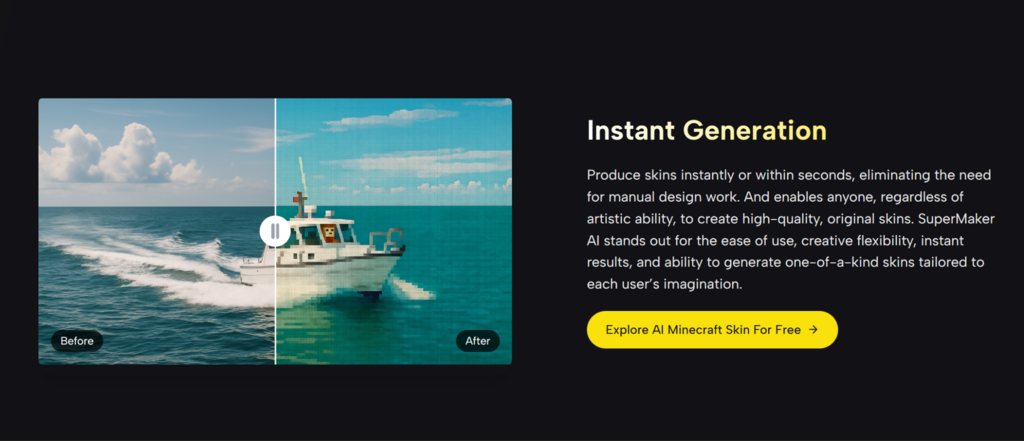
The official process supports rapid decisions.
Step One: Externalize The Idea Quickly
You express an idea without refining it internally for too long.
Why Speed Matters At This Stage
Fast externalization prevents overthinking and keeps ideas fluid.
Step Two: Judge Outcomes, Not Processes
You review the result without worrying about how it was produced.
Outcome-Oriented Evaluation
This encourages judging skins by feeling and fit rather than technical merit.
Step Three: Apply Or Discard Without Friction
Downloading and using the skin requires no extra steps.
Decisions Stay Lightweight
Because application is easy, trying multiple options feels reasonable rather than excessive.
Comparing Decision Dynamics
| Decision Aspect | Manual Editing | Image-Based Generation |
| Cost of change | High | Low |
| Risk tolerance | Conservative | Experimental |
| Commitment timing | Early | Late |
| Iteration speed | Slow | Fast |
This table highlights how tooling directly shapes thinking patterns.
Broader Implications For Player Identity
Customization is about identity, not just appearance.
Identity As Something You Test, Not Declare
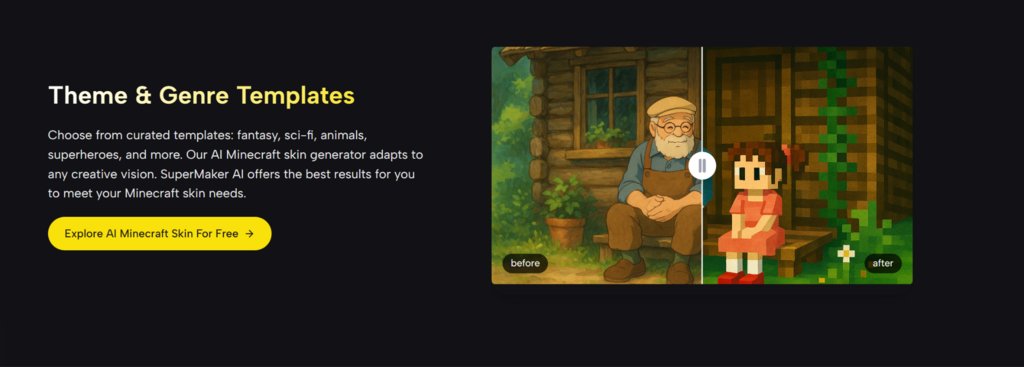
Lower decision cost allows players to explore identities temporarily.
Skins As Experiments
In my experience, players become more willing to change skins regularly, treating them as situational rather than permanent.
Where This Model Has Boundaries
Decision freedom can also overwhelm.
Too Many Options Can Stall Choice
Unlimited iteration may lead to indecision.
The Need For Personal Constraints
Some users benefit from setting their own limits, such as a fixed number of generations per idea.
Why Decision Dynamics Matter More Than Speed
The most significant change here is not efficiency, but mindset. Image-based skin creation reshapes how players decide, explore, and commit. It turns customization into an ongoing conversation rather than a one-time declaration.