

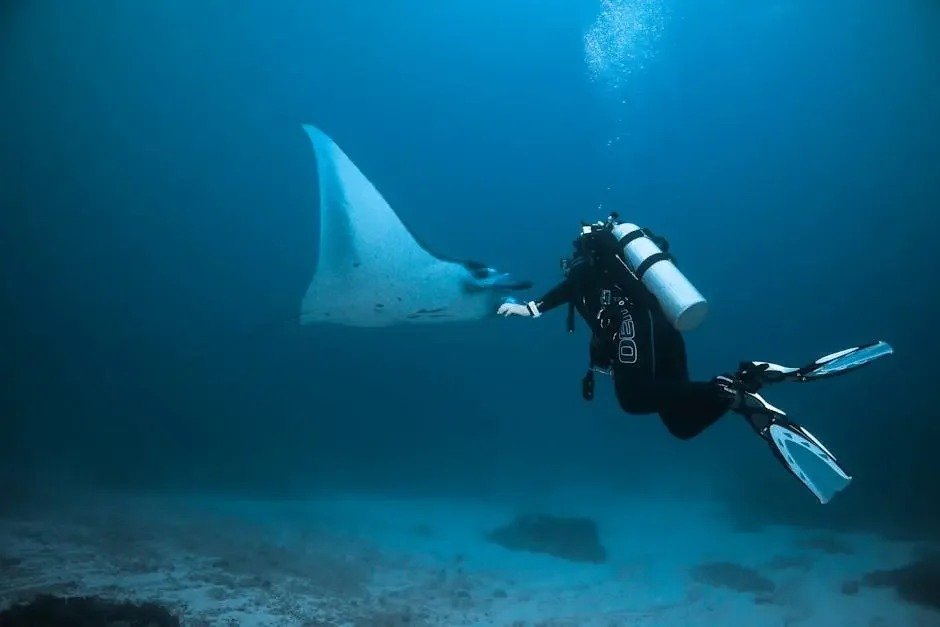
Of all the encounters scuba diving can offer, few compare to the feeling of hovering motionless beneath a manta ray as it glides overhead — wingspan stretched wide, body language completely unhurried, entirely unbothered by your presence. Manta ray scuba diving sits in a category of its own, and the Maldives is where it happens at its very best.
Why Scuba Beats Snorkelling for Manta Encounters
Snorkelling with mantas is wonderful. Scuba diving with them is on another level — and here’s the specific reason why.
On scuba, you can settle onto the reef at a cleaning station and become completely still. You’re not thrashing at the surface trying to keep pace with the animal. You’re not creating noise and splash. You descend, control your buoyancy, rest on the sand or coral, and wait. The mantas come to you.
This stillness changes everything. Mantas at cleaning stations are in a relaxed, focused state — they’re there for a reason and they stay as long as they need to. A diver who is quiet and horizontal on the reef below becomes part of the scenery. Some mantas will pass within arm’s reach. Some will circle the same spot for an hour.
Scuba also gives you time. A snorkeller gets a surface view for as long as they can swim alongside the animal. A diver gets the full experience — underneath, alongside, up close — for the duration of a full tank. There’s no comparison.
What Happens at a Manta Ray Cleaning Station
Cleaning stations are the engine of manta diving in the Maldives, and understanding how they work makes every dive richer.
A cleaning station is a specific section of reef — usually a coral outcrop or pinnacle — where small cleaner fish congregate. Wrasses and angelfish are the main species involved. They feed on the parasites, dead skin, and bacteria that accumulate on larger marine animals. Mantas are among their most regular clients.
Mantas arrive at cleaning stations on a predictable daily schedule, often tied to tidal movement and current. They slow to almost nothing, spread their wings, open their mouths and gill slits wide, and hover patiently while the cleaner fish work. Some individuals stay for just a few minutes. Others linger for over an hour, circling slowly in the same spot while the cleaners do their job.
For the scuba diver, the protocol is simple: descend quietly, find a neutral position on the reef, stay low, breathe slowly, and wait. The dive masters who know these sites have spent years watching specific mantas return to the same spots. They know where to position you and when to be there.
Top Scuba Diving Sites for Manta Rays in the Maldives
Manta Point — North Malé Atoll
The most iconic cleaning station in the Maldives. Reef mantas arrive daily, hovering at 12 to 15 metres while divers watch from below. The site is calm, relatively shallow, and ideal for underwater photography. Encounters here can last the entire dive.
Maaya Thila — Ari Atoll
A submerged coral pinnacle that draws mantas at dawn and dusk. The site also offers sharks, rich reef life, and exceptional night diving — making it one of the most complete dive experiences in the country. Manta encounters here feel more spontaneous and often more dramatic for it.
Dhigurah Manta Point — South Ari Atoll
Calm, clear conditions and reliable year-round sightings. Smaller groups of mantas make encounters feel intimate. Excellent for divers who want unhurried time in the water without dealing with strong current or high boat traffic.
Lankan Manta Point — Addu Atoll
For encounters with oceanic mantas — the larger of the two species found in Maldivian waters, with wingspans that can exceed 6 metres. Located in the remote south, best visited during the northeast monsoon (December to April). Worth the journey for experienced divers looking for something beyond the standard itinerary.
Two Types of Manta Ray — Know the Difference
Most divers don’t realise the Maldives hosts two distinct manta ray species.
| Species | Wingspan | Where Found | Season |
| Reef Manta (Mobula alfredi) | Up to 4–5m | Malé & Ari Atolls, cleaning stations | Year-round |
| Oceanic Manta (Mobula birostris) | Up to 6–7m | Southern atolls, open water | Dec – Apr (NE monsoon) |
Reef mantas are the ones you’ll encounter at cleaning stations — regular, predictable, and comfortable around divers. Oceanic mantas are larger, less commonly seen, and tend to appear in open blue water rather than on the reef. Encountering an oceanic manta on a deep wall dive is a rare and memorable experience.
Best Season for Manta Ray Scuba Diving
The Maldives offers manta encounters throughout the year, but the experience shifts significantly between seasons.
Dry Season (November – April): Calm seas, visibility up to 30 metres, and reliable cleaning station activity across Malé and Ari Atolls. The best overall conditions for scuba diving — stable weather, manageable currents, and consistent manta sightings.
Wet Season (May – October): Plankton blooms triggered by the southwest monsoon draw massive manta aggregations, particularly in Baa Atoll. Visibility may reduce slightly, but the encounter density — sometimes dozens of mantas at a single site — is unmatched anywhere in the world during these months.
Both seasons deliver outstanding manta scuba diving. The choice depends on whether you prioritise visibility and calm conditions, or raw spectacle.
How to Dive with Manta Rays Without Ruining It
The quality of manta ray diving in the Maldives is directly tied to how well divers behave underwater. Mantas that are harassed repeatedly will abandon cleaning stations they’ve used for years. Follow these rules on every dive:
- Never touch a manta — removing their protective mucus layer causes infections and long-term harm
- Stay horizontal at all times — vertical positioning signals threat in manta behaviour
- Do not approach from above or head-on — come from the side and below
- Keep your fins off the reef — sand clouds disrupt the cleaning station ecosystem
- No flash photography — use ambient light or a video light on low setting
- If a manta moves away, stay still — never chase it
A good dive master will brief you thoroughly before the dive. Follow their lead and you’ll have the encounter of a lifetime. Ignore the rules and you’ll spoil it — for yourself and for every diver who comes after you.
Why a Liveaboard Is the Best Way to Experience It
Resort-based day trips can deliver manta encounters, but they are limited by fixed schedules, single departure points, and limited time at the best sites. A liveaboard removes every one of those constraints.
Aboard the Spirit of Maldives by Spirit Liveaboards, your diving day is built around where the mantas are. The boat moves between atolls, responds to real-time sightings, and puts you in the water at the right place and the right time — multiple times a day. Small group dives mean less competition at cleaning stations and more space for genuine encounters.
The vessel itself offers 13 well-appointed cabins across three decks, a jacuzzi sun deck, Starlink internet, and buffet dining with complimentary wine or beer at dinner. Between dives, you recover in comfort. When conditions are right, you’re back in the water.
Frequently Asked Questions
Do I need advanced certification for manta ray scuba diving? Open Water certification is sufficient for most manta sites, which sit at 12–20 metres. Advanced Open Water is recommended for deeper sites and drift dives.
Are manta rays dangerous? No. They are filter feeders with no aggression toward divers. The only risk is an accidental collision — which is why staying low and still matters.
Can I touch a manta ray if it swims close to me? Never. Even unintentional contact removes the mucus layer that protects them from infection. Keep your hands to yourself regardless of how close they come.
How many mantas will I see on a dive? Cleaning station dives regularly produce 3 to 8 mantas. During peak season in Baa Atoll, aggregations of 50 or more are not unusual. Nothing is guaranteed — but the Maldives gives you the best odds on the planet.
The Maldives is the place for manta ray scuba diving. The population is enormous, the sites are exceptional, and the guides know these animals by name. Plan it carefully, dive it respectfully, and it will be the dive you measure everything else against.