

For years, the “creative process” has been a polite euphemism for a series of high-latency bottlenecks. In a standard production pipeline, the gap between a conceptual brief and a tangible first draft is often measured in days, if not weeks. This lag isn’t just an administrative annoyance; it’s a “feedback friction tax” that drains the momentum of a campaign before it ever reaches the market. When every iteration requires a round-trip through a specialized department or an external agency, the cost of being “wrong” or wanting to experiment becomes prohibitively high.
The recent shift toward generative workflows isn’t just about making “art” through a prompt. For most marketing and content teams, it is about the radical compression of the review cycle. By moving the point of asset generation closer to the point of strategic decision-making, tools like Banana AI are effectively dismantling the traditional gatekeeping of visual production. The goal is no longer to wait for a finished product, but to inhabit a state of continuous refinement where the “final” version is simply the last iteration of a very fast loop.
The Hidden Costs of Production Latency
In a traditional setup, a creative lead might describe a vision to a designer. The designer spends several hours—or days—mocking it up. The lead reviews it, realizes the lighting is off or the composition doesn’t quite hit the emotional beat, and sends it back. This asynchronous dance is where creative energy goes to die. By the time the third version arrives, the market context might have shifted, or the team’s enthusiasm for the original idea has waned.
This latency forces teams into a “safe” posture. Because iterations are expensive in terms of time, creators often stick to the first “good enough” idea rather than exploring the “great” one that might be five iterations away. The introduction of AI-native workflows changes the math. When you can generate a high-fidelity visual in thirty seconds, the cost of an iteration drops to near zero. This doesn’t just make the process faster; it changes the psychological approach to creation. You aren’t “ordering” an image; you are conversing with a system to discover it.
Operational Agility with Banana AI
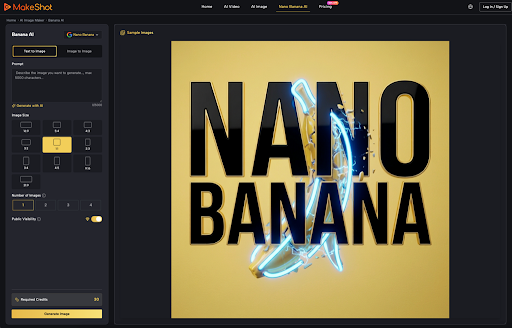
When we look at the practical application of these tools, the focus usually lands on the raw output quality. While fidelity matters, the real operational value lies in the flexibility of the engine. A robust system allows a creator to pivot between styles and formats without starting from scratch. For instance, using Nano Banana AI to move from a text-to-image prompt to an image-to-image refinement allows a team to lock in a composition and then iterate on the aesthetic “skin” of the asset.
This is a critical distinction in professional workflows. A random image generator might give you a beautiful result, but if you can’t replicate that result or tweak a specific element without changing the whole scene, it’s useless for a brand campaign. The ability to restyle, refine, and adapt visuals within a single interface reduces the “tool-hopping” that usually plagues creative teams. Instead of jumping between a generator, a traditional editor, and an upscaler, the workflow stays contained, preserving the “flow state” of the operator.
The Reality of Strategic Oversight
However, it is important to reset expectations regarding “one-click” perfection. A common misconception in the current hype cycle is that AI replaces the need for creative direction. In practice, the opposite is true. Because the velocity is so high, the demand for clear, strategic oversight actually increases. An AI Video Generator can produce dozens of clips in the time it used to take to render a single frame, but if the creative lead lacks a clear sense of brand identity or narrative flow, they simply end up with a mountain of high-fidelity noise.
The “one-click” promise is often a mirage when it comes to brand-specific typography or hyper-accurate product placement. While these models are getting better at understanding spatial relationships, they still lack the “intent” that a human editor brings. You might get a stunning landscape, but if the light is hitting the product from the wrong angle for the brand’s established visual language, it still requires manual intervention. The tool removes the labor of the “doing,” but it doubles the responsibility of the “deciding.”
Compressing the Video Production Loop
The same friction that exists in static imagery is magnified tenfold in video production. Traditional video workflows are notoriously rigid; once a scene is shot or a complex 3D render is started, changes are agonizingly slow. Integrating an AI Video Generator into the storyboard phase or the early conceptual stages allows teams to “see” the motion before they commit to heavy production budgets.
This “pre-visualization” phase used to be a luxury reserved for big-budget features. Now, a small content team can use Banana AI to generate a “moving mood board.” This allows stakeholders to sign off on a vibe, a pacing, or a color palette before a single camera is rented or a high-end editor is hired. It shifts the review cycle from “Let’s see what we got” to “This is exactly what we are going to build.” Even if the final output isn’t 100% AI-generated, the velocity gained in the decision-making phase is a competitive advantage.
The Constraint of Spatial Reasoning
We must also acknowledge the technical limitations that still exist. Spatial awareness remains a persistent hurdle for many current-gen generators. Asking for a very specific arrangement—such as “a red ball behind a blue box but partially obscured by a glass of water”—can still result in a coin-flip of success. Nano Banana AI provides tools to help mitigate this, such as image-to-image referencing, but there are moments where the model’s internal logic will simply override the user’s prompt in favor of “aesthetic probability.”
Understanding these limitations is part of becoming a tool-savvy creator. Rather than fighting the model to do something it struggles with, experienced operators learn to work around the edges of the technology. They might generate the elements separately and composite them, or they might adjust their creative vision to align with what the AI excels at—texture, lighting, and atmospheric depth. The goal is to be an operator, not just a prompter.

Delivery at the Speed of Social
The final stage of the creative pipeline is delivery. In the modern attention economy, the window of relevance for a piece of content is shrinking. A trend on social media might last forty-eight hours. A traditional production cycle simply cannot move fast enough to capitalize on these micro-moments. This is where the velocity of Nano Banana AI becomes a survival mechanism for brands.
When you can take a trending topic, generate a high-quality visual or short video clip, and have it ready for posting within an hour, you are playing a different game than the brand that needs three days of internal approvals and designer time. The ability to “restyle” existing assets for different platforms—turning a cinematic wide-shot into a portrait-oriented social ad with consistent branding—is a force multiplier for small teams. It’s about taking one core idea and exploding it into dozens of platform-specific assets without a linear increase in cost or time.
The Shift from Creator to Editor
As these tools become more integrated into the daily stack, the job description of the “creative” is shifting. We are moving away from a world where technical proficiency in complex software (like knowing every shortcut in a high-end video editor) is the primary value. The new value lies in “curatorial judgment.”
The operator uses Banana AI to generate twenty variations of a concept. Their skill isn’t in making the images—it’s in having the taste and the strategic alignment to know which of those twenty variations will actually resonate with the target audience. It’s about being an editor-in-chief of an automated production house. This requires a deeper understanding of psychology, marketing strategy, and narrative than ever before, because the “execution” part of the job is no longer the bottleneck.
Practical Integration: Starting Small
For teams looking to reclaim their creative velocity, the advice is usually to start by identifying the most painful bottleneck in the current process. It’s rarely the “final” masterpiece that needs AI; it’s the dozens of “v1” mocks, the social media variants, and the background elements for larger compositions.
By offloading these high-volume, low-stakes tasks to Nano Banana AI, teams can free up their human talent for the high-stakes creative work that requires deep empathy and complex reasoning. The “feedback friction tax” is real, but it’s no longer mandatory. The tools exist to bypass the wait times and move directly into a faster, more iterative, and ultimately more creative way of working.
The future of production isn’t about the removal of the human element; it’s about the removal of the pause button. When the gap between thought and visual representation vanishes, the only remaining constraint is the quality of the idea itself. And that, ultimately, is where we should have been spending our time all along.