

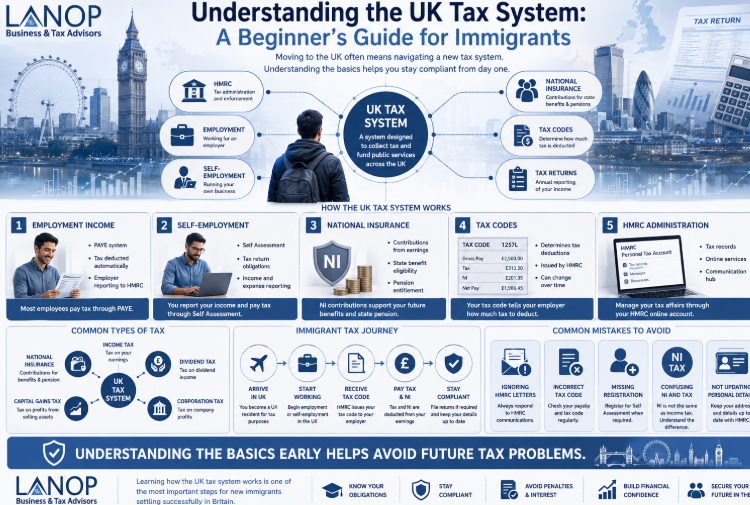
Moving to the UK means adjusting to a lot of things at once: a new employer, a new city, a new system. Tax tends to sit at the bottom of the priority list right up until an HMRC letter arrives and suddenly it becomes very urgent. Many immigrants in the UK pay the wrong amount of tax for months without realising it, miss obligations they did not know existed, or simply feel too uncertain about the system to ask the right questions. Working with a tax accountant for foreigners who understands the specific pressures new arrivals face can prevent most of these problems before they start. This guide covers what HMRC actually expects, how the UK tax system works in plain language, and what to do if something has already gone wrong.
Why the UK Tax System Confuses Most New Arrivals?
The UK tax system is not especially complicated once you understand its logic, but it is different enough from most other countries that the assumptions people bring with them tend to cause problems.
In many countries, the tax authority calculates your liability and sends you a bill. In the UK, the responsibility sits with the individual you are expected to know whether you need to register, file a return, or report additional income. HMRC does not typically send a reminder telling you that you have obligations you have not yet met. The silence is not reassurance.
The split between PAYE (Pay As You Earn) and Self-Assessment confuses people most. Employees have tax deducted automatically by their employer, which leads many to assume their tax position is fully handled. It may not be, particularly if they also have freelance income, rental income, or earnings from abroad.
Then there are the HMRC letters. Receiving official correspondence about tax codes or self-assessment registration tends to provoke anxiety rather than action, especially when the language feels bureaucratic and the consequences of getting it wrong are unclear. The honest answer is that most letters are routine, but some require a response and the distinction matters.
Your First Steps After Moving to the UK
The first twelve months in the UK set the pattern for your tax position going forward, and a few early steps make everything considerably easier.
The National Insurance number comes first. Without it, you can still work, but your employer cannot allocate your tax and NI contributions correctly until it arrives. Apply through the HMRC online service as soon as possible. Processing times vary, but applying early avoids payroll complications that become harder to untangle later.
Once employed, check your tax code. This is the number and letter combination on your payslip something like 1257L that tells your employer how much tax-free income you receive before deductions start. New arrivals sometimes end up on an emergency tax code, which typically results in too much tax being deducted. It is correctable, and HMRC will refund overpaid tax, but it is easier to fix at the start than to recover months later.
Set up a Government Gateway account early. This is the online portal through which HMRC manages most individual interactions, filing returns, checking tax codes, accessing records. Having it ready before you need it urgently saves time when it matters.
Track income from day one. Keep records of every income source employment, self-employment, any earnings from overseas. The habit costs nothing and proves invaluable if HMRC ever asks questions about a particular tax year.

Understanding HMRC in Plain English
HMRC His Majesty’s Revenue and Customs is the UK government body responsible for collecting tax, tracking income, and enforcing compliance. It is not a hostile organisation looking for reasons to penalise people, but it does expect taxpayers to engage with their obligations rather than wait to be prompted.
How does HMRC know what you earn? Employers report salary and PAYE deductions directly to HMRC in real time under a system called RTI (Real Time Information). Banks report certain types of interest. And under the Common Reporting Standard, financial institutions in over 100 countries including many home countries of UK immigrants share account data with foreign tax authorities. This means income held abroad is not as invisible to HMRC as many people assume.
The question of whether HMRC can see overseas income comes up constantly. The realistic answer: they may already have data they have not yet acted on. The safer assumption is always that overseas income should be declared rather than left unreported in the hope it goes unnoticed.
What It Is and Why It Matters?(National Insurance)
National Insurance is not income tax, and the distinction matters more than people realise. NI contributions fund state benefits the NHS, the state pension, statutory sick pay, and maternity pay. Income tax funds general government expenditure. Both are deducted from your pay if you are employed, which is why the combined deduction on a payslip can look higher than expected.
For immigrants specifically, NI contributions matter for long-term settlement reasons too. Qualifying for a full state pension requires a certain number of years of NI contributions. People who spend part of their working life abroad and part in the UK sometimes find their contribution record is patchy, something worth understanding early rather than discovering at retirement age.
How PAYE Works and Why Your Tax Code Matters?
PAYE is the system through which employers deduct income tax and National Insurance directly from your salary before paying you. It is designed to be automatic, and for employees with a single job and no other income sources, it generally works correctly without any action required.
The tax code is where problems most commonly appear. An incorrect tax code means incorrect deductions either too much or too little tax being taken. New starters, people changing jobs, or those with multiple employers frequently find their tax code needs reviewing. The most common emergency code, BR, taxes all income at the basic rate with no personal allowance applied which means paying more tax than necessary from the first day.
Checking and correcting a tax code is straightforward through the Government Gateway portal or by calling HMRC directly. What is less straightforward is noticing the problem in the first place, which is why many immigrants overpay for months.
Who Needs It and When?(Self-Assessment)
Self-Assessment is the system through which individuals report income that PAYE does not cover. Filing a Self-Assessment return is not a sign of doing something wrong.it is the correct process for anyone whose tax position is more complex than a single employment.
The clearest triggers are self-employment, freelance income, rental income from UK or overseas property, and income from abroad. But there are less obvious triggers too. An employee who earns over £100,000 must file a return even if all their income comes through PAYE. Anyone who received Child Benefit while earning over £50,000 (now £60,000 following recent changes) may have a liability through the High Income Child Benefit Charge. Someone with significant savings interest may need to file once that interest exceeds the personal savings allowance.
Deadlines are fixed and penalties for missing them are automatic. The registration deadline for new Self-Assessment taxpayers is 5 October following the end of the tax year in which the obligation arose. The online filing deadline is 31 January. Missing the filing deadline triggers a £100 penalty immediately, with daily penalties accumulating after three months. These penalties apply even if no tax is actually owed.
Side Income, Gig Work and the Trading Allowance
Uber, Deliveroo, Amazon Flex, freelance design work, online tutoring side income is common among immigrants supplementing employment income while building their life in the UK. The tax rules apply to all of it, and the threshold below which HMRC does not need to know is lower than most people expect.
The trading allowance gives £1,000 of self-employment income per year that can be earned without registering or filing. Beyond that, registration with HMRC as self-employed is required, and profits above the personal allowance become subject to income tax and Class 4 National Insurance. The registration deadline is 5 October following the end of the tax year in which self-employment began.
The most common and most costly mistake in this area is assuming that small amounts simply do not count. They do, and the obligation to register exists regardless of whether the ultimate tax liability is large or small.
Foreign Income and Overseas Reporting
UK tax residents pay income tax on their worldwide income. That includes rental income from property in another country, interest from overseas savings accounts, dividends from foreign companies, and income from overseas business activity.
The Common Reporting Standard, an international agreement between over 100 countries requires financial institutions to report account data to foreign tax authorities. In practice, this means HMRC may already hold data about overseas accounts and income sources that a taxpayer has not declared. Voluntary disclosure, when income has been missed, consistently produces better outcomes, lower penalties, simpler processes than HMRC-initiated investigation.
Common HMRC Letters and What They Mean?
| Letter Type | What Does It Usually Mean? | What to Do? |
| Tax code change notice | HMRC has updated your tax code | Check the new code is correct; contact HMRC if not |
| Self-Assessment registration notice | HMRC believes you need to file a return | Register and file by the deadline |
| Penalty notice | A deadline was missed | Pay the penalty and file immediately to stop further charges |
| Compliance check | HMRC is reviewing your tax affairs | Respond promptly; seek advice if the amounts involved are significant |
| P800 tax calculation | HMRC has calculated an underpayment or overpayment | Check the figures; claim a refund or arrange to pay |
The general rule is that HMRC letters should never be ignored. Most have time-sensitive response windows, and silence tends to be treated as non-engagement.
Can Tax Affect Your Visa or Settlement Application?
Tax compliance is increasingly visible in immigration applications. Settlement applications, ILR, and citizenship checks can involve scrutiny of HMRC records. A history of correctly filed returns, accurate NI contributions, and prompt response to HMRC correspondence creates a clean compliance record. Gaps, late filing, or unresolved liabilities create complications that are harder to explain once an immigration application is already in progress.
The practical advice is to treat tax compliance not just as a financial obligation but as part of the broader record of life in the UK that immigration decisions eventually draw on.
Real-Life Scenarios
Full-time employee: A software developer employed by a UK company has tax deducted through PAYE. No additional filing required unless they have other income but checking the tax code on the first payslip is essential.
Employee with a side hustle: A nurse who also does weekend freelance photography earns £4,000 from photography in a tax year. This exceeds the trading allowance, triggers Self-Assessment registration, and requires a return by 31 January.
New arrival in first year: Arrives in September, starts work in October. Needs to apply for NI number immediately, check employer has applied the correct tax code, and track all income from arrival date.
Foreign income earner: A UK resident who receives rental income from a property in Nigeria must declare that income on a UK Self-Assessment return annually, converted to sterling, with credit available for any Nigerian tax already paid.
Tax mistake correction: Filed a return that missed rental income from two years ago. The correction is made through an amended return or disclosure to HMRC acting before HMRC raises it reduces penalties significantly.
A Simple Annual Tax Checklist for Immigrants
- Confirm UK residency status at the start of each tax year
- Check tax code on first payslip after any employment change
- Register for Self-Assessment by 5 October if new income sources arose in the previous year
- Declare all overseas income rental, savings, dividends, business
- File Self-Assessment return by 31 January if required
- Keep records of all income, expenses, and HMRC correspondence for at least six years
- Review NI contribution record annually through the Government Gateway
When a Tax Accountant for Foreigners Is Worth It?
Most people with straightforward PAYE employment and no additional income can manage their UK tax position without professional help. The situation changes quickly once other income streams are involved.
Multiple income sources, overseas property, freelance or contractor income, HMRC letters about underpayment, historic years with potentially unreported income these are situations where working with a tax accountant for foreigners who understands both the UK system and the specific pressures immigrants face saves money, reduces risk, and removes the anxiety of not knowing whether the position is correct.
The DIY approach is fine when the facts are simple. When they are not, professional advice pays for itself in avoiding penalties and corrected overpayments alone.
Frequently Asked Questions
I just arrived in the UK and started working. Do I need to do anything about tax straight away?
Yes, and early action matters. Apply for your National Insurance number immediately, check the tax code your employer is using, new arrivals often end up on an emergency code that over-deducts tax and set up a Government Gateway account so your HMRC records are accessible from the start. These steps take little time but prevent problems that are considerably harder to fix later.
What is the difference between National Insurance and income tax, and why are both taken from my pay?
They serve different purposes. Income tax funds general government spending. National Insurance specifically funds the state pension, NHS entitlements, and benefits like statutory sick pay. Both are calculated on your earnings and deducted through PAYE before your salary reaches you which is why the gap between gross salary and take-home pay is often larger than new arrivals expect.
I work full-time but also do freelance work on the side. Does HMRC need to know?
Yes, once freelance income exceeds £1,000 in a tax year. You must register as self-employed by 5 October following the tax year you started, then file a Self-Assessment return by 31 January declaring both income sources. PAYE only covers your employment salary, anything earned outside that is your responsibility to report separately.
I have a savings account in my home country that earns interest. Does HMRC need to know?
Yes. UK tax residents declare worldwide income, including overseas savings interest. Under the Common Reporting Standard, financial institutions in over 100 countries share data with HMRC, so overseas accounts are not invisible. The interest must be declared on a Self-Assessment return, though tax already paid abroad is usually credited against the UK liability so you are not paying twice, but you are still obligated to declare.
I think I made a mistake on a previous tax return. What should I do?
Act on it rather than hoping it goes unnoticed. Returns can be amended within twelve months of the original filing deadline through the Government Gateway. For older errors, HMRC’s voluntary disclosure process handles exactly this situation. Proactive correction produces lower penalties and a simpler process than waiting for HMRC to raise the issue and the longer it sits uncorrected, the more interest accumulates on any tax owed.
Conclusion
The UK tax system rewards people who engage with it early and penalises those who leave things until they become urgent. For immigrants, the first year sets the pattern: getting the NI number, the tax code, and the Self-Assessment registration right from the start avoids corrections that cost time, money, and sometimes more when immigration applications are involved.
Lanop Business and Tax Advisors works with immigrants across the UK who are navigating the system for the first time, managing multiple income sources, handling overseas income obligations, or correcting past mistakes before they grow. From Self-Assessment filing and tax code corrections to foreign income reporting and HMRC disclosures, we handle the details so you do not have to piece it together alone.
When the basics are missed and need unpicking, that is where Lanop Business and Tax Advisors earns its cost many times over.