

You tap “buy.” A second later, your app says you own ten shares of some company. Feels instant. It isn’t.
Behind that single tap sits a chain of brokers, matching engines, and a settlement system most investors never think about. Understanding how stock market works at this level won’t make you a better stock picker overnight. But it strips away the mystery, and it quietly changes how you read your own trades.
Let me walk you through the whole journey of how stock market works, one link in the chain at a time.
It Starts With A Tap
Every trade begins with an order. How you write that order matters more than most beginners realize.
A market order says: fill me now, at whatever price is going. A limit order says: fill me, but only at my price or better. One prioritizes speed. The other prioritizes control.
| Order type | What it does | Best when |
| Market order | Executes immediately at the current price | You want in or out fast and the stock trades heavily |
| Limit order | Executes only at your set price or better | You care more about price than speed |
Get this part wrong and you can overpay by more than you ever saved skipping commissions.
Where Your Order Actually Goes
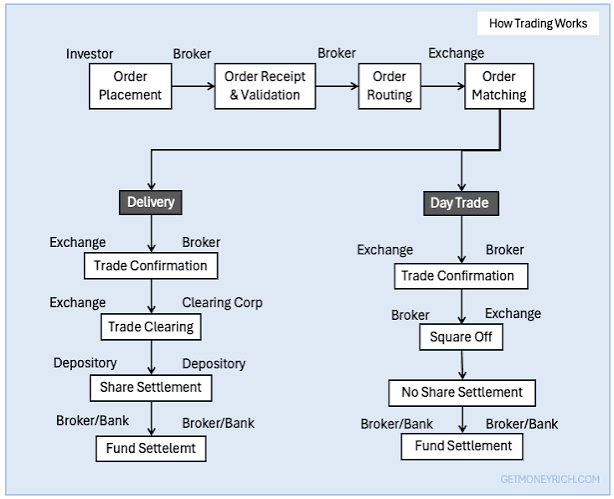
Here’s the thing nobody tells you. Your broker usually doesn’t send your order straight to the New York Stock Exchange.
Most retail orders get routed to wholesale market makers instead. Firms like Citadel Securities or Virtu. These firms pay your broker for the right to fill your trade, a practice known as payment for order flow. It’s a big reason your app can charge zero commission.
The market maker either fills the order from its own inventory or passes it to an exchange such as the NYSE or Nasdaq. This invisible routing layer is a large part of how stock market works today, even though you never see it happen.
The Match That Makes A Trade
A stock trade needs two sides. A buyer and a seller who agree on a price.
The exchange’s matching engine handles this in microseconds, pairing your buy order with someone else’s sell. The gap between the highest price a buyer will pay and the lowest a seller will accept is the bid-ask spread. On a heavily traded stock like Apple, that spread is a penny or two. On a thin, rarely traded name, it can get ugly.
When the two sides meet, the trade executes. Your screen flashes a confirmation. Psychologically, you own the stock now. Legally, not quite yet.
Clearing And Settlement, The Part You Never See
This is where how stock market works gets genuinely interesting.
Execution is a promise, not a transfer. Before money and shares actually change hands, the trade passes through clearing and settlement. The National Securities Clearing Corporation nets millions of trades against each other, so brokers move only the net difference rather than every single transaction.
Then settlement finalizes it. Since May 2024, the United States has run on a T+1 cycle, meaning your trade settles one business day after it executes. (It used to be two.) The Depository Trust Company records the change of ownership, and only then is the share truly yours. For you, that one-day gap is the reason cash from a sale often can’t be withdrawn the instant the trade shows as filled.
What Owning A Share Actually Means
You probably picture a paper certificate with your name on it. Almost no one has that anymore.
Your shares sit in “street name,” registered to your broker’s nominee and ultimately held at the Depository Trust Company under a single name, Cede & Co. Your broker keeps the record showing those shares belong to you. It sounds indirect, and it is. It’s also what lets you sell as fast as you bought.
Want your name directly on the company’s books? You can use direct registration. Most investors never bother, and honestly, for active trading, street name is simpler and quicker.
Conclusion
Next time your app says “order filled,” you’ll know what that really covered.
The order routed, a market maker or exchange matched it, a clearinghouse netted it, and a day later the shares settled into an account held in your broker’s name on your behalf. That full sequence, from click to ownership, is how stock market works underneath the friendly green button. If you want the layer beneath this one, why prices actually move, how stock market works at the valuation level is the natural next step.
Knowing the plumbing won’t pick your winners. But it makes you a calmer, more deliberate investor. And that edge compounds.