

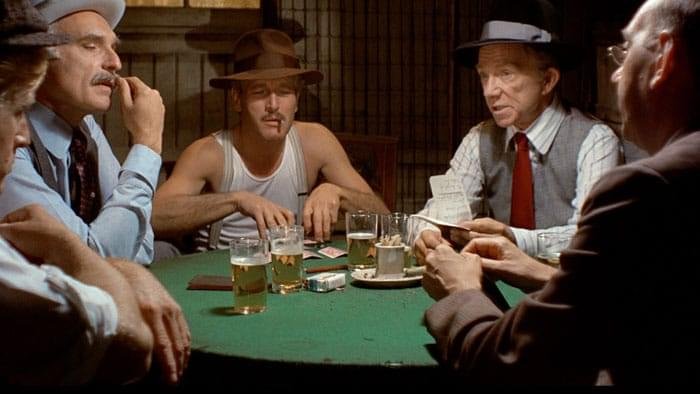
Five films have shaped how most Western audiences picture a poker game. Each of the five centers on Texas Hold’em rather than five-card stud or draw, which makes sense given the game’s rise to mainstream visibility after the 2003 World Series of Poker Main Event. The scenes themselves vary in technical accuracy, but the strongest of them share a common structure. They build the stakes through small hands, reveal character through betting patterns, and resolve the conflict on a single board that the audience can follow in real time. The five films below are the ones that did this best.
Casino Royale and the Montenegro Tournament
The 2006 Bond reboot built its third act around a Texas Hold’em tournament at the Casino Royale in Montenegro. The buy-in sat at $10 million with a $5 million rebuy. Ten players. Winner take all on a potential $150 million pot if every player rebought. Daniel Craig played Bond. Mads Mikkelsen played Le Chiffre, a French Algerian financier laundering terrorist funds through poker tournaments.
The final hand ran a board of 4♠ 6♠ 8♠ A♥ A♠. Le Chiffre held 6♥ A♣ for an aces-full-of-sixes full house. Two other players hit lower full houses. Bond turned over 5♠ 7♠ for a straight flush. The scene runs eight minutes from the first hole-card reveal to the river decision, which gives the audience enough time to track the math without rushing the dramatic beats. The technical accuracy is mostly intact. The improbability of four players all flopping or filling premium hands on a single board is the only major liberty.
Rounders and the Final Hand
Rounders (1998) covers a New York underground poker world built around stud and mixed games. The final scene returns to Texas Hold’em. Matt Damon’s Mike McDermott faces Teddy KGB, played by John Malkovich, in a heads-up cash match. The pivotal hand has McDermott calling a $15,000 raise on a flop with rags, then turning over the winning hand. Rounders cemented a generation’s interest in poker before the televised tournament boom and is still considered required viewing inside the professional community.
The film’s lasting reputation comes from its dialogue more than its hand structure. Mike Sexton, Phil Hellmuth, and Daniel Negreanu have all credited the film with pulling them deeper into live poker. Mike McDermott’s voiceover sets the standard for how the game would be narrated in every subsequent poker film.
Molly’s Game and the Underground Circuit
Aaron Sorkin’s 2017 directorial debut, Molly’s Game, follows Molly Bloom, a former Olympic-class mogul skier who ran the highest-stakes underground Texas Hold’em game in Los Angeles and then New York between 2004 and 2013. Jessica Chastain plays Bloom. The buy-ins at her tables reached $250,000. Players included Hollywood actors, professional athletes, hedge fund managers, and eventually members of the Russian mob, which is what brought FBI attention.
The poker scenes themselves are competent but secondary to the legal narrative. Sorkin focuses on the structure of the game economics, the rake, the bad-debt collection problems, and the legal exposure rather than the math of any individual hand. The film grossed $59 million worldwide on a $30 million budget and earned Chastain a Golden Globe nomination.

Lucky You and the WSOP Main Event
Curtis Hanson directed the 2007 film Lucky You, which stars Eric Bana as Huck Cheever, a young Las Vegas poker professional trying to qualify for and run deep in the World Series of Poker Main Event. The film captures the routine of grinding satellites and cash games for bankroll, the relationship friction the lifestyle creates, and the specific feel of the WSOP at the Rio. Drew Barrymore plays the love interest. Robert Duvall plays Cheever’s estranged father, a former poker champion who also makes a deep run in the same Main Event.
The poker consultants on the film were active tournament professionals, and the hands shown are mathematically correct from start to finish. Lucky You captures what it actually takes to make it as a professional in the Texas holdem world without softening any of the rough edges. The film underperformed at the box office, partly because it was released the same week as Spider-Man 3, but has aged into one of the more respected poker films within the professional community.
High Roller and the Stu Ungar Story
The 2003 biographical film High Roller covers the rise and collapse of Stu Ungar, a poker player who won the World Series of Poker Main Event three times. Michael Imperioli plays Ungar. The film tracks Ungar from his early gin rummy career through his first WSOP win in 1980, his second in 1981, and his comeback win in 1997, a year before his death.
The Texas Hold’em scenes are reconstructions of actual final tables. The 1980 final hand had Ungar holding 5♠ 4♠ against Doyle Brunson’s A♥ 7♥. The board ran 7♣ A♣ 2♠ K♥ 3♥, which gave Ungar a wheel straight against Brunson’s aces. The film tracks the hand close to the historical record. Imperioli’s performance grounds a story that could easily have slid into hagiography, and the poker scenes themselves feel like archival reconstructions rather than dramatizations.
Common Threads Across These Films
The five films share a structural pattern. Each centers a single climactic hand built around a board the audience can read in real time, and each uses the betting sequence to expose character rather than merely shuffle chips. The technical accuracy varies, with Casino Royale taking the most liberties for spectacle and Lucky You staying closest to the actual tournament rhythm. The scenes that hold up under repeat viewing all share one thing. The director treats the cards as supporting material for the human conflict at the table, not as the conflict itself. That ordering is what separates a forgettable poker scene from a memorable one, and it is what every film on this list does well. The next decade of poker films will likely keep this structure, since the math of a televised hand has not changed, and the dramatic vocabulary of bet sizing, hesitation, and the reveal remains as workable on screen as it was for the 2006 Bond reboot.