

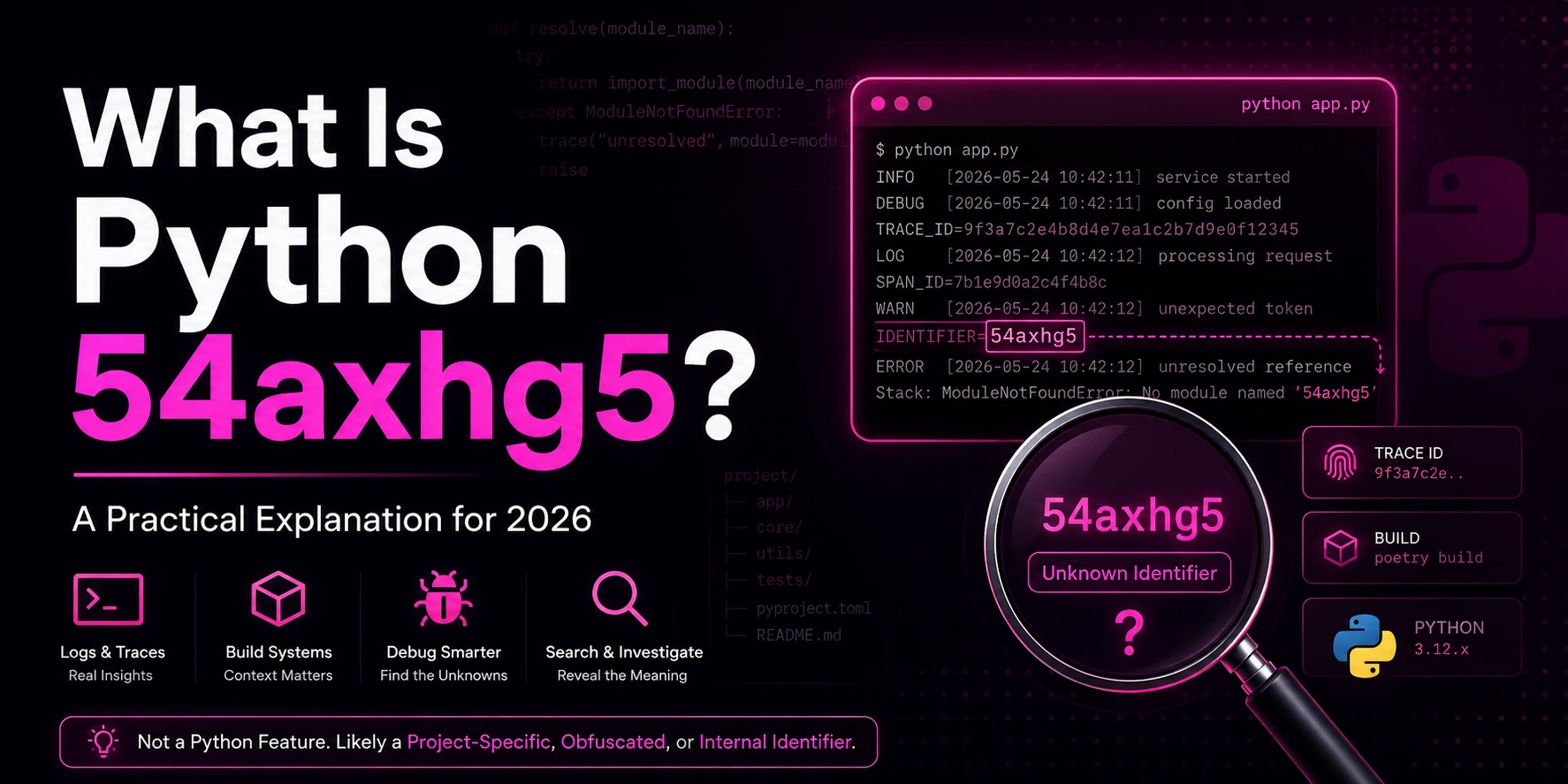
Python 54axhg5 may look like a technical term at first glance, but it does not belong to any official Python release, module, or command. Instead, it is more likely a random identifier that appears in development environments, logs, or online content without having a defined meaning in Python itself.
When encountering this term, the best approach is to pause and examine its context rather than assuming it represents a real feature or tool.
Quick Answer
Python 54axhg5 is not an official Python feature or version. It does not exist in Python’s documentation, release notes, or standard library.
In most situations, it is simply a generated label or identifier used within a specific environment, such as a build system, test run, or temporary file.
Understanding the Term
The phrase combines Python, a well-known programming language, with 54axhg5, which resembles a randomly generated string. These types of strings are commonly used in software systems to uniquely identify processes, files, or tasks.
Because of this, python 54axhg5 should be interpreted based on where it appears rather than treated as a standalone concept.
Is It an Official Python Term?
No, it is not official. Python follows a structured versioning system, such as Python 3.11, 3.12, or 3.13. These versions are clearly documented and follow predictable naming patterns.
A mixed string like 54axhg5 does not match Python’s naming conventions. Any legitimate Python feature or release would be documented through official channels, including release notes and technical documentation.
Why Does It Appear Online?
Terms like this often show up because technical-looking phrases can spread across websites, especially when they are picked up by automated content or repeated without verification.
Over time, repetition can make such terms appear more credible than they actually are. However, visibility alone does not confirm authenticity.
Possible Reasons for Its Appearance
- It may be generated by a build or deployment system
- It could be part of a log entry
- It might be used in temporary scripts or files
- It may appear in test outputs
- It could be reused in online articles without proper context
Where You Might Encounter It
Identifiers like python 54axhg5 are not unusual in development workflows. They often serve as internal references rather than meaningful labels.
| Location | Possible Purpose |
|---|---|
| Log files | Tracking runtime events |
| Build outputs | Identifying specific builds |
| Test reports | Labeling test executions |
| File names | Temporary or generated files |
| Online content | Repeated or unclear references |
If the term appears in your own project, reviewing the surrounding files or scripts usually reveals its origin.
Is It a Python Package?
There is no verified information suggesting that python 54axhg5 is a legitimate Python package. Any claim that it can be installed should be treated carefully.
A genuine Python package typically includes proper documentation, version history, and a trusted source. Without these elements, it is safer to avoid installation.

Before Installing Anything
Consider the following:
- Is the package listed on a trusted platform?
- Does it have clear documentation?
- Are the developers or maintainers known?
- Does your project actually require it?
If these questions cannot be answered confidently, it is best not to proceed.
Is It Safe?
The identifier itself is neutral. Seeing it in a log or file does not automatically indicate a problem. However, caution is necessary when it appears in unfamiliar scripts, downloads, or commands.
If the term is linked to unknown sources or requests system access, verifying its origin becomes essential before taking any action.
How to Investigate It
Understanding the context is the most reliable way to interpret python 54axhg5.
Steps to Follow
- Review the full message or file where it appears
- Search your project for the exact string
- Check build configurations and automation scripts
- Examine nearby log entries for clues
- Confirm any related tools or packages through trusted sources
These steps usually clarify whether the identifier is part of your system or unrelated noise.
What It Is Not
Python 54axhg5 does not represent:
- A Python version
- A standard library module
- A built-in command
- A recognized error code
- A performance feature
- A verified package
Understanding this helps avoid unnecessary confusion during debugging or development.
Best Practices for Developers
Using clear and descriptive identifiers can prevent misunderstandings like this. Instead of relying on random strings alone, combining them with meaningful labels improves clarity.
For example, using build_id=54axhg5 or job_ref=54axhg5 makes it easier to understand what the identifier represents.
Tips for Better Naming
- Add descriptive prefixes to identifiers
- Maintain structured logging formats
- Document internal naming conventions
- Avoid unclear or temporary file names
- Clean up unused identifiers regularly
These practices make projects easier to manage and debug.
Final Thoughts
Python 54axhg5 is best viewed as a contextual identifier rather than a defined Python concept. Its presence usually relates to internal processes such as builds, logs, or temporary files.
The key is to focus on context. By examining where the term appears and verifying its source, it becomes much easier to understand its purpose and avoid unnecessary confusion.
FAQs
What is Python 54axhg5?
It is not an official Python term. It is most likely a generated identifier used in a specific environment.
Is it a real Python feature?
No, it does not exist as a Python version, module, or built-in feature.
Should it be installed?
No installation is recommended unless the source is verified and clearly documented.
Why does it appear in logs?
Automated systems often generate unique identifiers to track processes, which can appear in logs.
Can it be removed?
If it is part of your project, search for it in your files or scripts. If it only appears in logs, removal may not be necessary.